Que sais-je? La musique concrete

by HRM on June 21, 2011

Book review by Lendl Barcelos

La Musiqu Concrete

Title: Que sais-je? La musique concrète
Author: Pierre Shaeffer
Publisher: Presses Universitaires De France
Date Printed: 1967
Pages: 127
Format: Paperback
Language: French
Colour: Sea-foam
Smell: Musty, but still fresh
Size: Coat-pocket
Marginalia: No

She entered the café as I was reading one of the shorter stories in Borges’ Fictions. Let me explain two things before I continue:

1) It has been two months since I’ve been reading Borges. His name did not signify much for me before this; he was, however, on the list. After too many friends had scoffed at the lack of Borges in my life, I figured it was time to begin. A couple of stories into the collection and I now realize they were perfectly right to ridicule. It is difficult to keep up with the individuals whose projects intersect with yours, but when you do find them, a little part of you dies…or better, their name replaces that part.

2) I have a habit of reading the shortest stories in a collection first. Brevity is key.

She sat with her back towards me; she must’ve not been interested in starting up a conversation (not that I’m capable of such action, anyway). The thought also crossed my mind that perhaps she was waiting for someone else, but this turned out to be pure speculation, and untrue.

We both ordered chocolat (for the uninitiated, this simply means a hot chocolate). I reckoned she must also hate coffee. This was to be our first connection.

Since her face was out of view, I decided to continue reading. I began to read a longer story in order to prolong my stay at the café. Her sea-foam green dress and matching shoes caught my eye and, out of sheer chance, our glasses emptied in unison. Our time was coming to an end; she had settled her bill.

After a quick trip to the foul-smelling toilet, we met face to face in the doorway for a too-brief moment. As I exited and she went in, I could only hope that she would not assume the smell had me as a referent.

I paid my bill and left; she was still inside. My opportunity to initiate communication had definitely passed. Walking slowly toward Shakespeare & Company, the bookshop across from Notre Dame, her stride overtook mine. At the thought of this being another connection, she turned right. My destination was to the left. Our paths were now completely divergent.

Arriving at my goal, I began, as always, to look through the used books when a stack fell to the floor. Picking them up, I was greeted by the sight of the same woman as before. This defied all logic and how exactly it occurred, I have yet to understand. We stared directly into each others eyes; I am not keen on initiatory gestures. Both of us were unsure of what to do next, but she immediately darted away from Shakespeare in the direction of the rue Saint Michel. This signalled the end of our third connection.

Once she’d left, I picked up one of the fallen books. It was La Musique Concrète, by Pierre Schaeffer. An original from 1967 with a wonderful purple and sea-foam green cover for only €1. I could not pass this up. After all, Schaeffer, a pioneer in sound, was one of the first to separate a sound from its referent.

{ 0 comments }
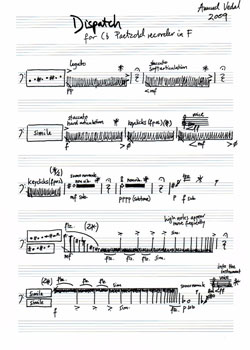
Amund Vedal -­­ Dispatch

by HRM on June 20, 2011

Music from the Norwegian composer

Dispatch (2009) by Amund

DispatchAmund Vedal is a composer and musician from Norway studying composition in Gotland, Sweden. Dispatch (2009), for contrabass recorder, was first performed by Swedish recorder-virtuoso Anna Petrini. Unedited.
contact: amundvedal@gmail.com


{ 0 comments }

Exoticism and imagination

by HRM on June 11, 2011

The Literary Conference: Agadir, Morocco - Day 2

There is an inherent problem in my being here, in Agadir, a town on the coast of central Morocco, to cover and participate in a literary conference. The theme of the conference is space and I am not from this place, have never been to this part of the world [1], and do not speak the language spoken here, my tongue unable to articulate, my mind unable to decipher, the fluid warblings of Arabic. I was not told until I arrived that the conference would be entirely in Arabic and there were no official translators on hand.

Some of the time, I was able to get people to take notes for me, to whisper what was going on as the conversation continued around us. “They’re talking about villages,” Salma said, at one point. “Now they’re talking about revolution.”

Occasionally, I was able to let my mind wander along what I believe might have been a path remotely resembling the one the speaker was marking out. Guided by signposts I recognized – Proust, Kafka, Marquez – I started thinking about space imposing isolation and solitude, unending labyrinths and how memory recreates space.

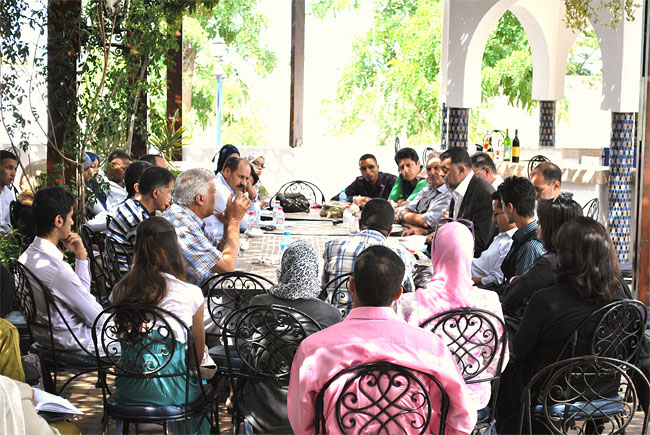
Group photo

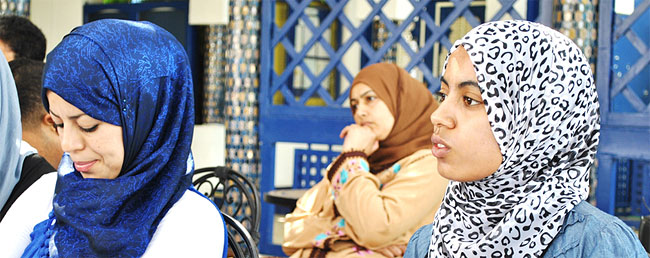
Perhaps my being here, a foreigner, an utter outsider to this place, this language and this culture – I am one of two women participating, and we two are two of four not wearing headscarves (there are about 15 women in the audience of a total of about 60) – is relevant to the theme of the conference. I am not referring to the long and convoluted history of the relationship between the Self and the Other, the local and the foreigner, the colonizer and colonized; I mean only that, in this case, the outsider sees things differently, without the same limits.

When it is my turn to speak, I introduce myself in French, apologetic and defiant. I bring up the idea of the foreigner in Arabic literature, and the role of the visitor or the expatriate as either creator or subject. This is the only truthful thing I can discuss. Having just read the first part of Lawrence Durrell’s Alexandria Quartet, Justine, I was wondering whether the narrator, a British man, sees things more truthfully, or at least more acutely, for the distance his outsider’s perspective provides. Round tableOr does this foreignness lead to the undesirable (and terribly passé) “exoticizing” of his subject: the city of Alexandria and its inhabitants? Sometimes it takes a foreigner to observe a place, to be fascinated and enchanted by everything he sees. Henry Miller said that only painters can see their subjects with loving eyes, and the writer is cursed to perversion, or at least pessimism, when depicting the world. Lawrence Durrell loves what he sees and is enchanted by what he experiences.
Ibrahim Abdel-Meguid, born and raised in Alexandria, brings up the imagination: the Alexandria that Durrell creates is wholly imaginative even in the writer’s own words. The lives he writes about are lives based on selected fictions and memories distorted by loneliness and lost love. Synonyms for lost: misplaced, disoriented, vanished, bemused, bewildered, forlorn, helpless, spellbound, at sea.

The city, half-imagined (yet wholly real), begins and ends in us, roots lodged in our memory. Why must I return to it night after night, writing here by the fire of carob-wood while the Aegean wind clutches at this island house, clutching and releasing it, bending back the cypresses like bows? Have I not said enough about Alexandria? Am I to be reinfected once more by the dream of it and the memory of its inhabitants? Dreams I had thought safely locked on paper, confined to the strong-rooms of memory!

– Balthazar, Lawrence Durrell (second instalment in The Alexandria Quartet)

The village in Arabic literature

Mohamed Azeddin Tazi, novelist, and Mohamed At Iaâmim, critic, believe that the lack of novels representing Arabic villages and villagers comes foremost from the inability to portray these subjects without a sense of pity that prevents readers from truly empathizing with the story.

Headscarves

The question hangs: Is it possible to write a story depicting a village in a way that is both honest and interesting?

I saw Canadian writer Alistair McLeod discuss his work a few years ago in Halifax, Nova Scotia. In the auditorium at the University of King’s College, McLeod talked about the small Maritime villages he depicts in his novels and short stories. One of his largest readerships is in East Asia, he said, proving that people don’t need to be from a place to be interested in that place; as long as the story truthfully depicts relationships, life and the human condition, people are able to relate to it. Nobody here has ever heard of Alistair McLeod.

Several people approach me after the discussion, downright befuddled about my identity, my role. “You’re not from here? You don’t speak Arabic? But you were taking notes all throughout,” they say, “and you looked so attentive.”

“I thought you were a writer too,” I reply, “don’t you take notes and look attentive, too?”


[1] My African tourism has taken me only so far south as Marrakesh, as east as Essaouira.


{ 3 comments }

When life is larger than art

by HRM on June 10, 2011

An interview with Sahar Elmougy

Sahar Elmougy

Egyptian novelist Sahar Elmougy wears a bandana; the wild mane underneath is revealed when we arrive at the hammam. Her eyes are alive, alert. We disrobe calmly and wait on the bench with our towels and black mitts.

BakingThis interview was conducted in three parts: in the back of an orange taxi on the unpaved streets of Agadir, and then in the industrialized and unadorned hammam where the women who work there spent half an hour going over our skin with the rough mitt, thrice until raw. Our skin red and fresh, our host drove us to her friend’s house where we were welcomed into the salon with the most elaborate of tea-ceremonies: home-made pastries and oily crepes awaited us along with their selection of accompaniments arranged in white porcelain bowls. The conversation continued there: five women in a circle talking literature, politics and revolution.

Interview by Harriet Alida Lye, as part of the Agadir Literary Conference

HRM: How does physical space affect narrative and character in your work, and the way you see contemporary Arabic literature in general?

SE: Needless to say that “space” is an integral part of the fiction text, be it a novel or a story though in varying degrees. As for my own work, all my writings take as their focal point the inner transformations of the characters, their moments of illumination, moments of seeing differently. This usually happens in a space that acts as a womb for such transformations. It does not have to be the classical romantic setting of the desert (though there are instances of this in my last novel “Noon”), but it could happen in a mundane surrounding such as the character’s own home.

However, in the Agadir conference, I chose not to talk about space in my work. I rather talked of the desired space, the space not yet written. Tahrir Square, the throbbing heart of the Egyptian revolution. I talked of my experience there on 28th January, the bloodiest day of the revolution. How, within the span of eight or nine hours I had retrieved my sense of belonging to the homeland. Seeing the spirit of resistance of all the thousands who were there fighting the bloody vampire of the Egyptian security body. The teargas, running towards Tahrir, the soul of a whole country returning, rising like a long dormant Phoenix out of its own ashes. This is a space that acted like a crucible of transformation for many, actually for a whole nation. It is quite an intimidating moment to write because at that moment, “life” was much larger, more amazing then “art”.

Sahar Elmougy

HRM: The novel has been said to be a Western invention. Do you agree? How do you feel about working within this convention?

SE: Though this may be true, I do not think this distinction should be a problem. On the one hand, the East has produced various narrative forms long before the novel was born as a Western genre. The Arabian Nights is a witness to this fact. But cultures have kept inseminating one another throughout history. Can one say that “ideas” have a nationality? Look at Facebook, isn’t that a Western invention? But did its inventors ever imagine it would be used as a tool of throwing up dictatorships as in the case of the Arab revolutions! I view your question in the same light. What matters is how you use and develop the genre.

HRM: Does the female writer have a different role than her male counterpart in contemporary Arabic literature? Regarding your particular role in this conference, how did it feel to be the only woman participating?

SE: Well, they share with the male writers some basic grounds. How they portray their societies, diagnose their illnesses…etc. But since women have entered the field of writing no more than a century and a half ago (with few exceptions), they are performing a long awaited task, that of speaking out women’s lives, saying the unsaid. Male writers have written men, women and the world. It is high time women write men, women and the world. Adjusting the intellectual balance of humanity is the goal. As the only woman writer in the Agadir conference, I simply felt I was a comrade to my fellow writers.

Sahar ElmougyHRM: Siri Hustvedt, an American writer, recently said at a reading in Paris that women writers will always be “barking from the margins.” What do you think of that statement?

I do not agree with this opinion. If we, as women, believe we are “barking from the margins”, that will be the case. It is true the literary arena hosts more male than female writers, but readers also crave the “other” point of view. How can we ever write if we believe ourselves to be on the margin? In order to write, we have to believe we are in the throbbing heart of literature.

HRM: And what are you currently working on?

SE: I am working on a new novel where the five main characters are women, obsessed women. Like the characters of my other works, I guess they will be going through inner transformations. But it is far too early to know what will happen to them.

A lecturer of American and British poetry at the Faculty of Arts in Cairo University, Elmougy is also a radio presenter of a cultural show concerned with writing. The show is presented on the English Local Service of Radio Cairo every Tuesday. She also works as a part time gender and creative writing trainer, translator and columnist in Elmasry Elyoum daily. Having started writing in 1994, Elmougy now has four books, two collections of short stories and two novels. Her two novels have received prizes in the Arab world as well as internationally.

{ 2 comments }

The Devoid

by HRM on June 9, 2011

Flash fiction by Lacey Haynes

The Devoid

The crows came quietly again last evening. In the space between lightness and darkness when I sat alone in my study, I saw them like an oil slick in twilight pouring heavily across the sky. I wanted to tie them each down with red yarn and watch their bodies bobbing on currents. Their wings pinched in place, each one sitting in dark contrast to the pin pricks of light, my buoyed black anti-stars wrapped in veins of red. That dear old Prelude in E Minor rolling along somewhere in the background. I felt the notes in my face and hands and organs. I could have bitten through my lip just to hear those searching sounds again. Through the scope of a pane of glass the murder climbed out of sight. I leaned forward, craning and caught them. Swirling together in a dance, unfettered but moving as if caught in some inescapable rhythm. Cadence, my old friend.

I could see them tied down. It was better that way. It would keep them from diving towards a glint only to severe a wing on a jagged can. Chewing through plastic rings and choking. Coated in tar drowning in secret in pits the same color as their feathered forms. So I would take each of their bodies gently folding wings into place. Rocking easily in my wooden chair amidst piles of red yarn, I will move with delicate fingers. The music then will be loud, flooding in but not breaking the almost imperceptible winged resistance. Clenching and measured, I would win. Pinning with thumb and forefinger, tying knots methodically, coiling each body with precision. After each was encased, I would push it through the opened window setting it free to the sky. It would fall quickly but somehow be caught on a gust, jetting it high into the murky air. Each body the same, precariously black then ink blue melting into the changing skyscape. In the space where light slips softly away, my yarn will always be red and glowing, loud and calling to me in audible melodies. I watch the group of birds screaming silently with open beaks. Their wings flap in unison, singing to me from memory, their subtle ghost songs.

{ 1 comment }

ISSN: 2116 34X