This isn’t Proust

by HRM on July 5, 2012

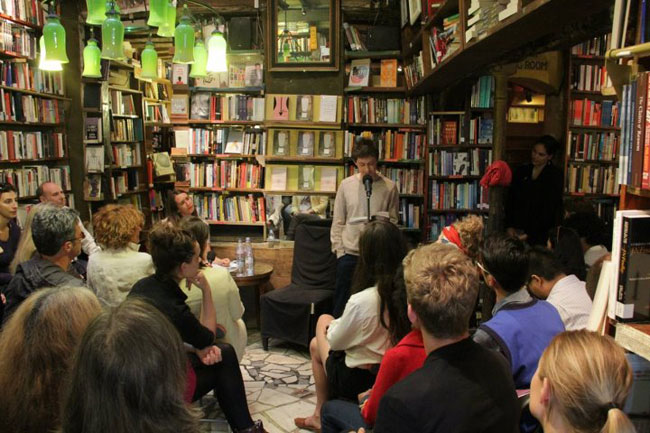
Lydia Davis at Shakespeare & Company

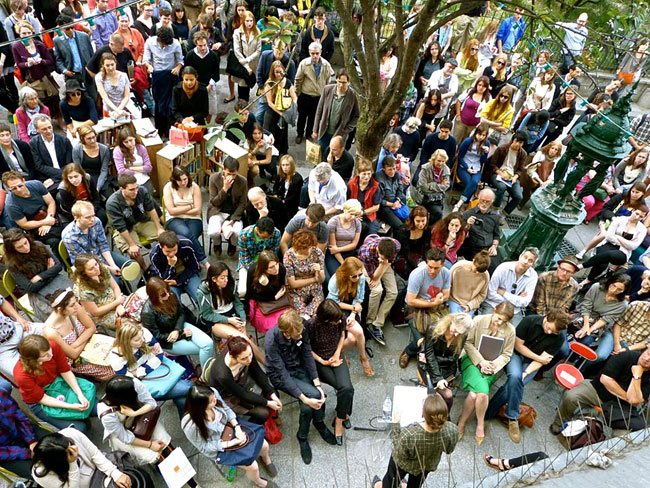
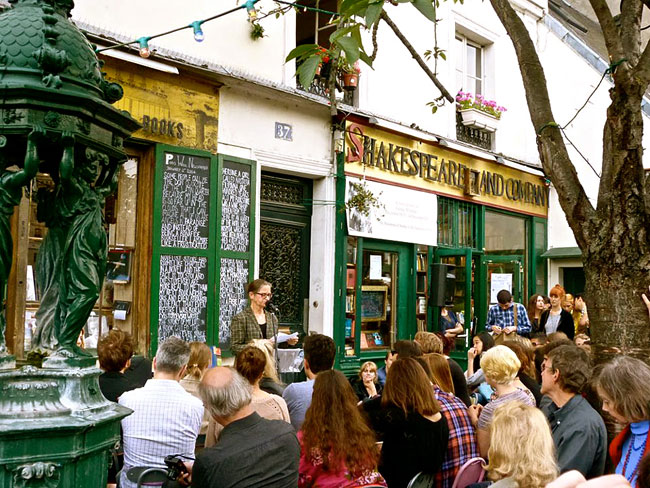
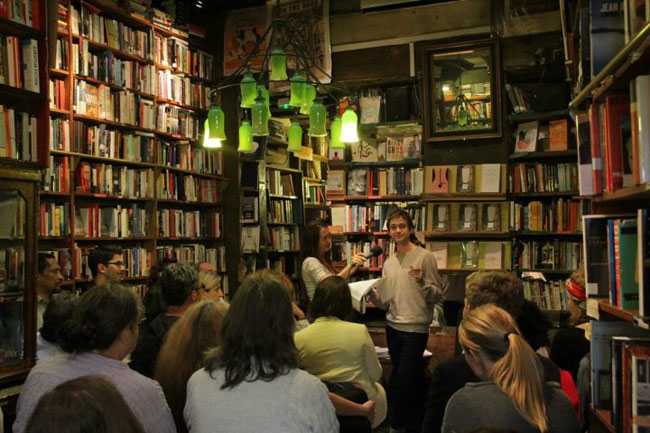
On Monday, June 26th, Lydia Davis visited Shakespeare and Co. She read a sampling of recent work, stories which varied in both topic and length, some no more than a few sentences long. As always, we found her prose to be tonic: humorous in its absurdity, melancholy in situation. The following is a transcribed and edited version of the question-and-answer session that followed the reading.
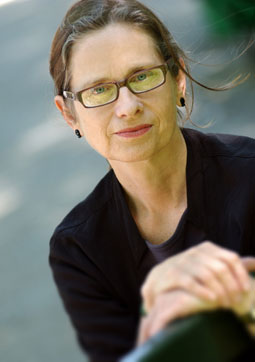
Lydia DavisDiscussed: Beginnings in Paris; the sanctuary found in notebooks; death and mittens; a concise Proust; the ploddingness of prose; a woman’s body in contrast to her personal charms.

Q: It seems that the land that you have cultivated for yourself, and it seems completely your own, is to take moments that other writers might not realize are stories and make stories out of them, out of moments that don’t completely fulfill that definition. And I was wondering if it took a long time to have the confidence to say that two women having a two-minute conversation about a sweater comprises a story, because it really does, and I don’t know many writers who have the confidence to take that risk.

Lydia Davis: I’m sure, for one thing, I wouldn’t have written such short stories when I was first starting out to write. I was in Paris for a lot of the time, the very beginning of trying to learn how to write. That’s sort of irrelevant, but I can’t help mentioning it because—here we are. I wasn’t always happy here, but I was working hard anyway.

So I don’t think I would have had the confidence, and I wouldn’t have even thought that well, that’s a story. When you’re young, you’re somehow more ambitious. You think, ‘First of all, I should be writing a novel, but if I somehow can’t do that, fall short of it, I should at least be writing a long, meaningful story. Certainly not something really short.’

But the nice thing is that you can write in privacy. So you have your notebook, and you could just write it down because you heard the woman say it. And you could look at it again, an hour later, and say ‘Well it would be a little better this way.’ But it doesn’t commit you to anything, and you find it delightful. I had serious doubts that it was enough, but I found it delightful. That’s a really quite recent one.

So I just sit on it for a while. Not literally, but I let it be for a while, and I keep coming back to it. And if it still feels it has some substance, I finally say OK. I dare to send it in a group. If a magazine asks me for a story, I like to send more than I really want them to take. I mean, they’re very small. Partly because I want to see. It’s a way of testing the story. So if it keeps getting pushed aside by one magazine after another, I think maybe there isn’t enough.

But it depended mostly on me. And I found that delightful.

There’s a very short poem by Anselm Hollow. I should be able to quote it completely because it’s so short, but that doesn’t mean I remember the whole thing. It’s called “The Red Mittens,” I think, or “The Mittens,” or maybe it has no title. But I had it up on my bulletin board a long time, and it was just a few lines: “The red wool mittens are almost finished. I’ve been working on them for many years.” See, I think I’m doing it completely wrong. But the last line is “But my life is over.”

It was so simple, so I knew it very well, although not well enough to quote it obviously. But I found that every time I read it again it still had an impact on me. So I guess that was sort of the model for these very short ones. Does it still have an impact, even though you know it well and it’s so short.

That’s a long-winded answer to a very concise question.
Lydia Davis

Q: In sentence-making, what propels you forward and what makes you stop?

LD: That’s very difficult, because it’s different in every case. I do hear everything in my head, so I hear it, and I hear it in a certain way before I write it down. I guess that’s probably true of most people. But one sentence inspires the next one, and that inspires the next one.

I have a sense of the form, the shape, and the length of the story almost before I begin. Sometimes it’s incorrect, it’s wrong, but most of the time I know it’s not going to be anything longer than this paragraph or these two pages. The ending is very difficult. Either because I don’t have the wording quite right or I haven’t actually come to the end of the thought.

In “Jane and the Cane,” the very first one, I didn’t know how to end that for a while. The last sentence is something like “Mother complains that she’s always so tired of Jane and Cane.” By that time, I’m tired of it too. We’re all tire of it. And there’s been the theme of tired going through it. But that didn’t come right away. I had to wait for that last line.

And then even in the very short ones I’ll do a lot of revising, just to get the absolute right wording. And a lot of cutting. It might just be a word or two.

Q: I first came across your work through your translations of Maurice Blanchot. And so I was wondering if you think they affected your other work?

LD: I actually started working on the first [Blanchot translation] here [in Paris], L’arrêt de mort. I’ve translated six of his books, so they must have had an effect, but it’s a little hard to know exactly how much, unless I had a parallel life in which I didn’t translate Blanchot, or didn’t translate anything maybe.

But I think I was very drawn to translate him because what he was doing in his work felt very—I won’t say familiar, but I felt at home with it. He goes into great detail. He takes one encounter, and will open it up to form a whole book. He’ll make an abstract thing like a thought become a character. It was that focus, that relentless focus on detail that I found very interesting. He didn’t need a huge cast of characters and a lot of dialogue. So he was very spare.

Of course, then Proust was—but then I don’t know. Proust said he was very concise, too. And I agreed with him. He said that he never put anything more in one sentence than should be in that one sentence. So if it was very long, that could still be concise.
Lydia Davis

Q: I was wondering whether you call the very short pieces poems, and whether this makes a difference.

LD: It’s more complicated than that, actually, because some of the short pieces I did write intending them to be poems. Others I intended them to be prose, but wanted the lines to be broken because I wanted you to stop at the end of those lines. So even though I didn’t call them poems, they look like poems on the page. But I still think I come from short story, beginning. I never considered myself a poet.

There’s a certain ploddingness to prose that I like. It can be repetitious in an interesting way with language. But I wanted that sort of heaviness. “Jane and cane.” I didn’t want it to be too lyrical.

So in a way it’s arbitrary.

You can see it as a continuum from what is absolutely and unmistakably a poem, say a Shakespeare sonnet or something. And then, at the other end, Tolstoy’s War and Peace, which is unmistakably not a poem, although you find very long prose works that are called poems by their authors. It’s nicely confusing, I think.
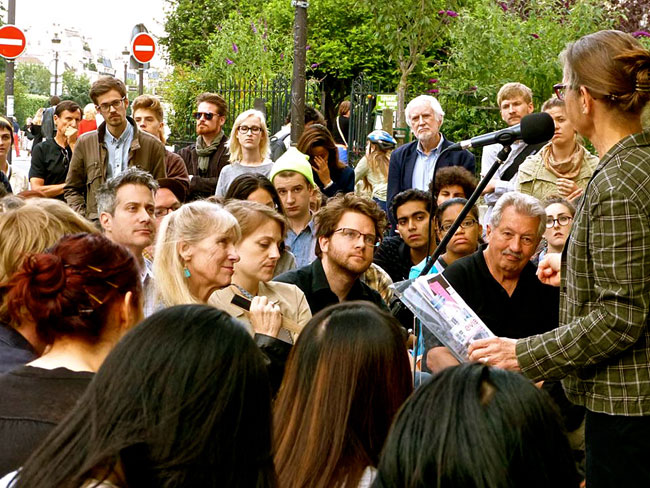
Lydia Davis

Q: How does your translation of Proust differ from past editions? And were you and the other translators given any specific instructions as to some method that was different from the past translators?

LD: There’s really only one past translation—Scott Moncrieff. And then there have been two revisions of that translation. But a great deal of his original work is still in the revisions. So I really think of it as one, one previous translation, with revisions. Important revisions, but.

My translation was part of a group project, I did the first and then there were other translators for each of the other volumes.

In terms of how mine is different from Scott Moncrieff: it’s much closer to Proust. Of course I would say that. There are loyal fans of the Scott Moncrieff translation, and if that was the first version you read than when you read Proust, many people just can’t see any other version as being Proust. They really say that is Proust.

His version was more flowery than the original, and more wordy. He would use “strange and haunting,” when Proust just said “strange,” “étrange.” He would say “strange and haunting” for the rhythm of it. So his rhythms were quite nice, and even his prose is quite nice in a way. But Proust is much more spare, much more modern. The Scott Moncrieff translation is rather Edwardian not just in language but also in sensibility. It is famous for avoiding—instead of saying “woman’s body,” Proust would say “body,” and Scott Moncrieff would say “personal charms.” And things like that.

Some of these survived the revisions. Proust said “the entrance to the underworld”—that’s the original, the plain French—and Scott Moncrieff says “the jaws of hell.” So he’s replacing “entrance,” which is a fairly neutral word, with “jaws,” a metaphor. A dramatic metaphor. So all the way through he adds metaphor, he adds words. He dresses it up. It’s more wordy. So I feel there’s an important difference. But of course people who grew up with the Scott Moncrieff read mine and say, “This isn’t Proust.” They really make that fundamental mistake.

{ 0 comments }
Shopping for friends

by HRM on July 3, 2012

Berlin's new web series

webseries

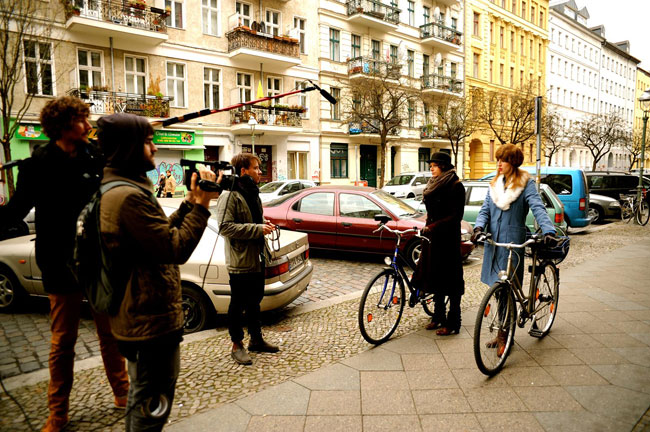
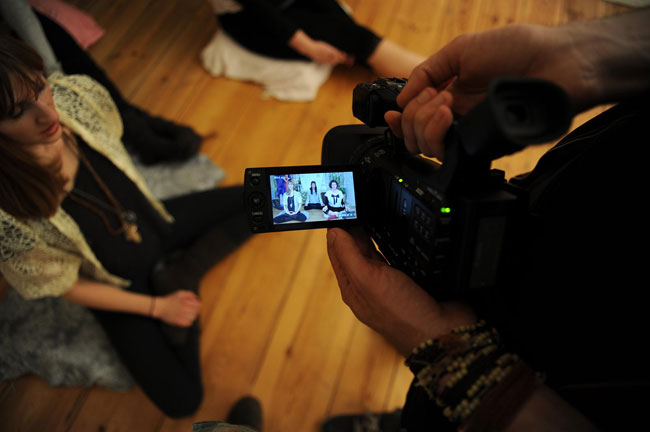
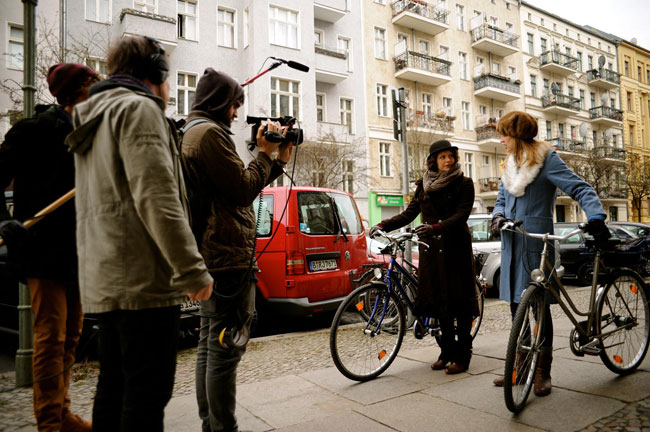
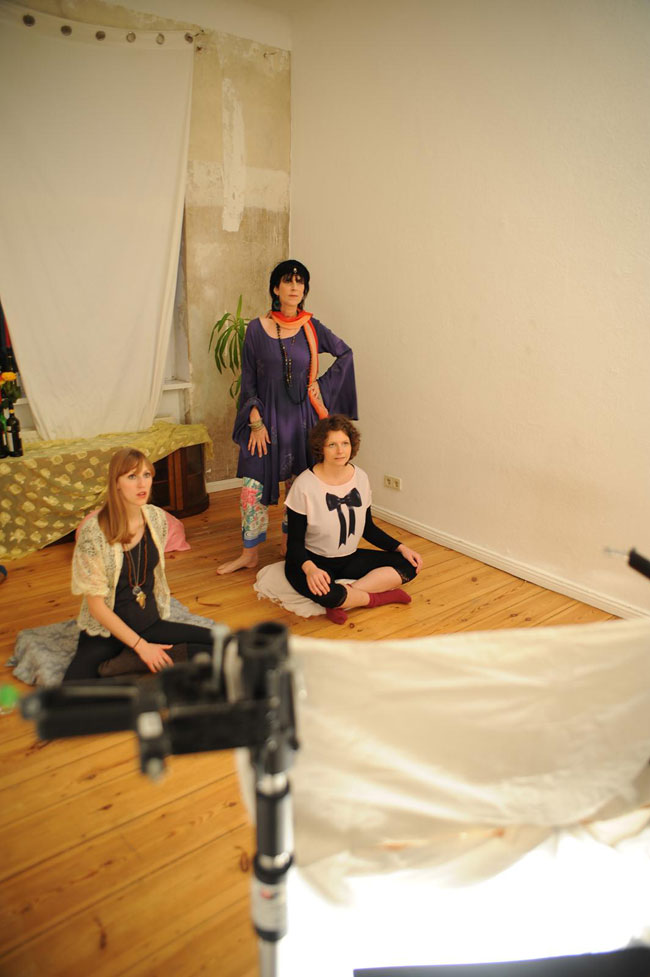
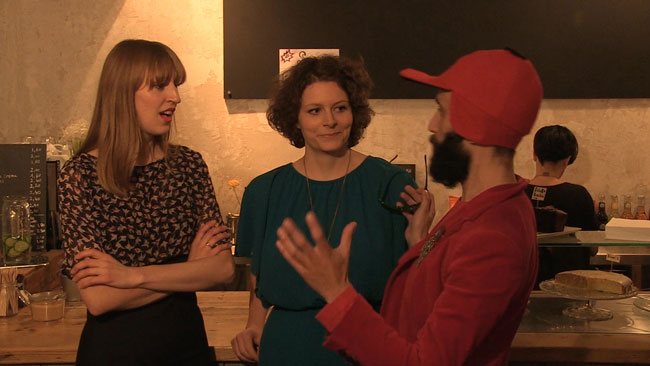
Lacey Haynes, Her Royal Majesty’s contributing editor, went a bit Woody Allen in creating this new web series based in Berlin: she wrote it, co-directed it, and stars in it. But unlike Woody, Lacey and her team did all of this without a budget. From actors to editors to locations and crew, “shopping for friends” was created by a team of passionate and devoted volunteers and a supportive Berlin community.

Why did you want to make a web series? 

Vanessa (co-creator) and I had just wrapped a theatre production here in Berlin. We were a) trying to become friends with one another and b) trying to get a project on the go. We ended up acting in this Haptic film on a rooftop in Kreuzberg for some students. It was on Super 8 and we basically had to make out and be lovey with one another. This was a good post-play ice breaker and we decided after to embark on a creative mission together.

I had never even heard of the web series genre before Vanessa introduced me to it. She’s savvy about these kinds of things. We were both interested in digging into a project that was all our own and this seemed like the ideal way to do so: to create something designed for the web, something quick and snappy that would enable us to flex our skills, and that other people would hopefully enjoy while trolling the world wide web.

webseries

What are the benefits of the medium?

It’s actually a really great way to wet one’s feet. I have been working as a writer and as an actor but have rarely cross fertilized and performed my own work (save for a couple of nude feminist projects in uni). I wanted to know whether I was capable of making a film project – writing, directing, producing, -really doing all of the tasks. Vanessa has a background in filmmaking and acting so it felt like we had the skills in place to go for it.

The medium of the web series is open and forgiving. It can exist within any scope of budget and quality and the format can also be pretty self-prescribed. There are no rules, or at least none that we felt held to, and this really enabled us to explore. We financed the project on a budget of rocks and peanuts, so to achieve what we have, we’re really happy. As well, being able to release it on our own terms and reach an international audience, it’s really quite ideal for one’s first foray into the world of making films.

webseries

What was the process like?

The process was good and challenging. I feel like I slammed out the script within a month but we didn’t finalize it until just days before starting to shoot. We had a solid crew of six people, including Vanessa and I, plus other actors, extras and people on location. We were so fortunate to have a creative Berlin community behind us. We were given costumes by clothing shops, free use of locations, and a lot of talented professionals giving their time. We shot the show in the autumn of last year but didn’t finish the editing until just a month ago. It was amazing to me that five episodes of about four minutes each required over 70 hours of editing. The main editor David and I really slogged it out at the end but that was such an empowering experience. I realized that I knew what I wanted the project to look and feel like and that I could make that happen.

Managing expectations is also really interesting in a project of this nature. Everyone expects things from everyone else, and those expectations can either be met, not met or exceeded. It’s a learning experience for everyone involved – I mean we had two ex-MTV producers, Nick and Pawel, filming and assisting with directing. We had people with a lot of experience in their fields to people who were just learning their craft. When there is no money but a strong will to achieve professionalism and quality, you have to be resourceful. Plus you have to inevitably reach the point where you settle on some things just so you can give birth to the project.

webseries

How did you draw from your own experience? 

The show is about making friends. Everyone can relate to this. In Berlin, people are always coming and going – one day you’ll have a solid crew of amigos and the next, everyone will have ventured back to their respective corners of the globe. Vanessa and I talked about this a lot – the experience of making friends, keeping friends and letting friends go. I had referred to the process of going out and meeting people as shopping for friends – thus, shopping for friends the web series was born.

-Berlin launch party RIAS Bar, Kreuzberg – piano music, full viewing 05.07.2012 (doors at 8, viewing at 10)

-Online episode 1 launch 09.07.2012, 1 episode every Monday for 5 weeks.

All photos in this article are by Brigid Annand excepting the first, which is a still from episode 3.

webseries

{ 0 comments }

Un Samedi

by HRM on July 2, 2012

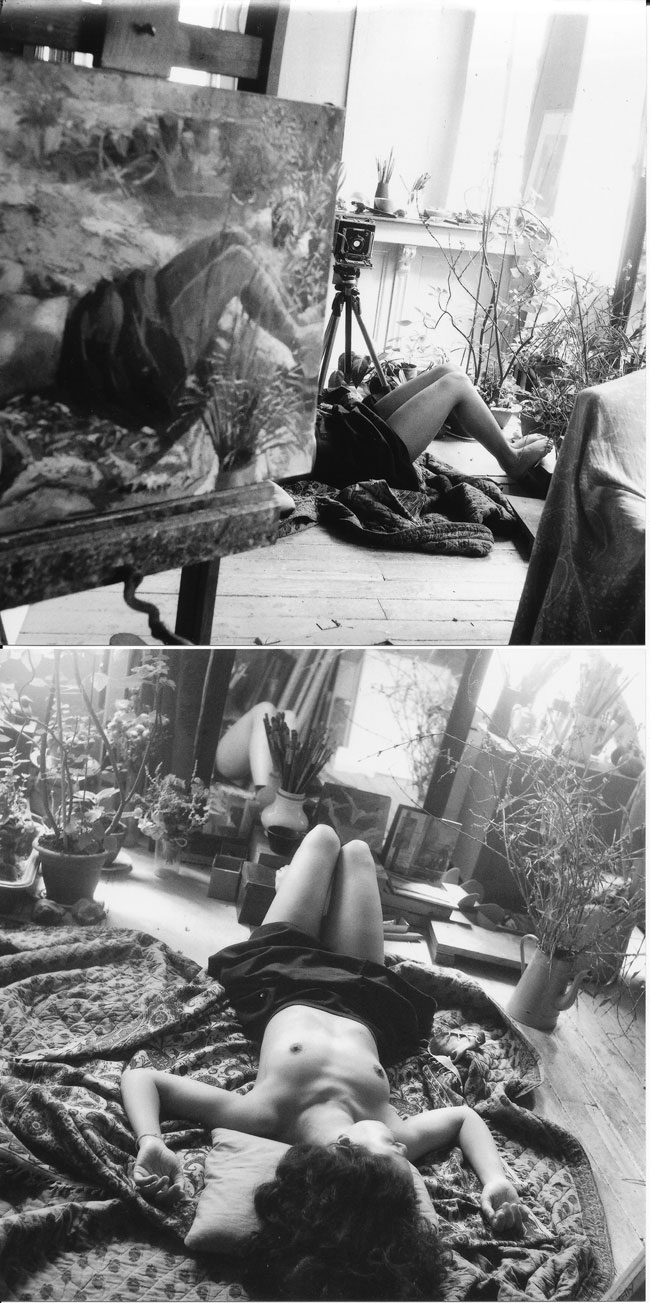
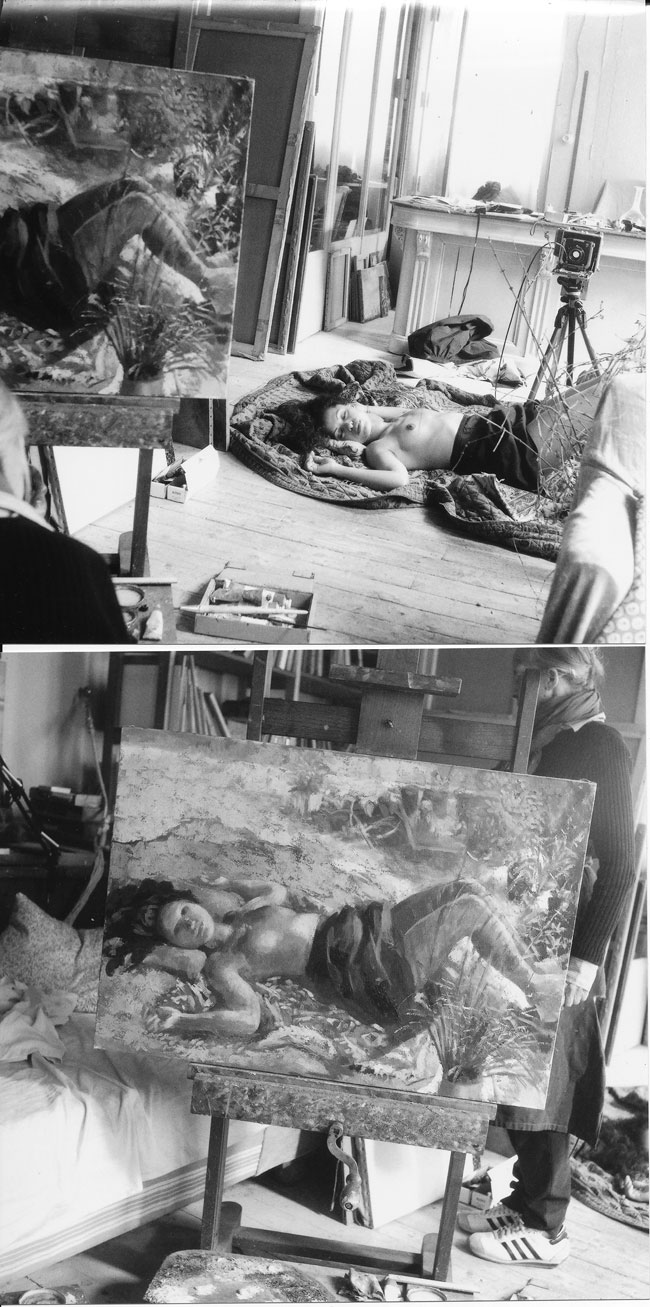
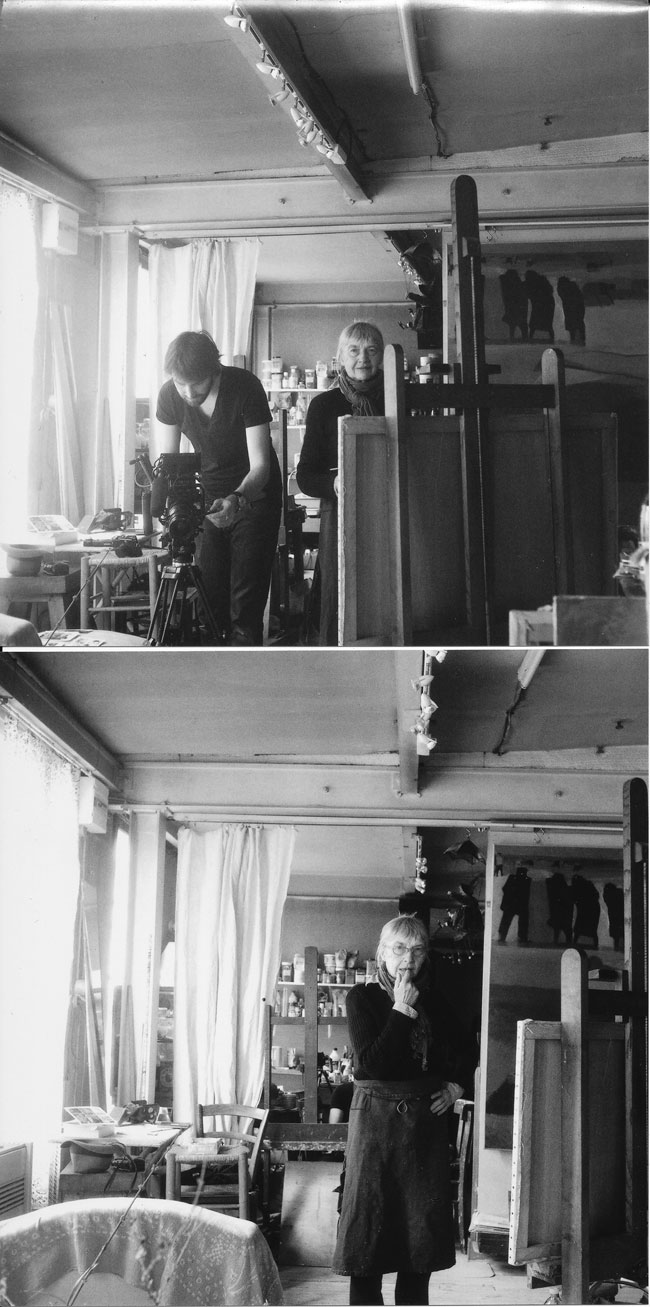
Bernadette Kelly and Kit Brown in the studio

Two artists, one subject. Bernadette Kelly paints Diane while Kit Brown photographs her; Sam Gordon and Ambarish Manepalli film them at work in the studio. Like jazz, the artists riff off one another.

Zooming out, there is an interesting theme of old and young here in terms of the artists and their mediums: the older artist is working with paint, the younger artist with photography, and the two film-makers, even younger, captured the whole thing on film.

redfilmshoot

redfilmshoot

redfilmshoot

{ 0 comments }

Crash! Bang! Wallop!

by HRM on June 28, 2012

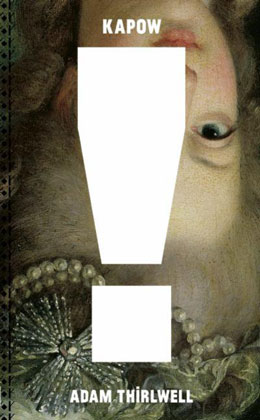
Adam Thirlwell goes 'Kapow!' at Shakespeare & Company

Adam Thirlwell came to Shakespeare and Company on Monday, June 18th, to read from his newest book, Kapow!, published by Visual Editions. The following interview is transcribed and edited from Adam’s conversation with Jemma Birrell, as well as the question and answer period following the reading.

Adam Thirlwell

Discussed: the trap of fiction; the unintended consequences of drinking; the importance of laundry vans; an unknown Cairo; the inherent authenticity of warts; and romance.

Her Royal Majesty will be publishing the interviews from Shakespeare & Company’s entire summer series, including the authors involved in NYU’s Summer Writing Program.

Kapow book coverJemma Birrell: Can you tell us all a bit about how this project started? Did you approach Visual Editions publishers, did they approach you? And how did it all come together?
Adam Thirlwell: The first book Visual Editions published was a reissue of Tristram Shandy, which they sent to me (I think I must have written about it, and so they knew I loved it). So I went for a drink with them and within two or three drinks I had seem to have signed a contract to do a new book with them, which was not entirely my intention in having a drink. And they said this wonderful sentence: “there’s nothing you can ask us to do that we can’t do – you can’t think something too difficult.” So obviously that was a challenge that I wanted to try and meet.

I think a lot of it was I had this idea in my head that I was going to try to write the most digressive thing ever written.

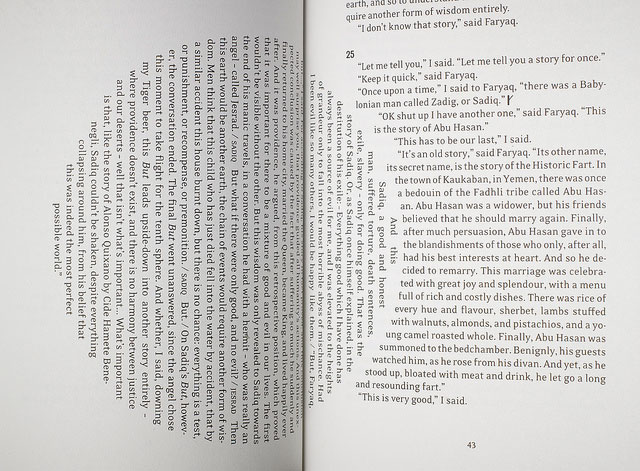
Visual Editions specializes in putting writers together with design studios, and they had just done this book by Jonathan Safran Foer, Tree of Codes, a book entirely made of holes. And so I don’t know if in some competitive way I wanted to do a book that was the opposite of holey, that was kind of expandy or something. And so the designs—basically I just wanted a design that would be readable with a million of these tiny digressions. It was the design studio that came up with various ideas, and the one they finished with was this idea that the text would go in different directions on the same page, and that if there was a digression that was so long, then it would somehow expand into a fold out.

JB: Were you thinking about which sentences would be those digression, as you were writing it? Or did this come after the fact?

AT: It was a bit of both. I definitely wrote as digressively as possible. Actually what happened was, at first VE gave me the templates where I actually did have word counts. I don’t know if people have seen their other books, but they’re actually obsessed by the idea that every book has to be the same height. So there was a page size that was unchangeable. And this therefore meant that because the design studio had chosen the font they liked, I was basically not in charge of this book at all. There was a certain word count to the page that I had to follow, and therefore they gave me various word counts of how long the digressions could be in relation to the page.

JB: Kind of Oulipian.

AT: Yes, it was actually quite easy to write. Easier because I was writing to this constraint. But at the same time I wasn’t entirely sure of exactly where it was going to happen. I think, when I was first writing it, I wasn’t sure if they would determine the digressions, or whether it would be me, and so in the end I ended up writing something even more digressive then I intended. I basically tried to make every sentence a digression in some way so that they could just happen anywhere.

The digressions were eventually settled on, I think mainly with what I thought should be the digressions. In the case, for instance, of the very long foldout, they had always wanted this idea that this book would get crazier and crazier. The visual digressions early on are relatively readable, and the idea was that the as narrator got more and more insanely caught up in the story, and the story within the story, the digressions would become even more upside-down and back-to-front, culminating in this point where the whole book falls apart, and nine pages fall out.

There were only four or five hours before the book went to print when we realized that there was now nine blank pages on the other side, which none of us had thought of. With five hours to go, I got phoned up with them saying we need a 563 word digression, and so I had to write that at the last minute. So it was a very weird collaboration.

Kapow inside

JB: Why did you choose to write about this subject – the Arab Spring? I know in the book the narrator is interested as an outsider to look around it.

AT: Yes, there’s a point where the narrator, who is obviously just a cartoon version of me as normal, says ‘I’m half-Jewish and I’ve always had this desire to write an Arab novel.’ That idea of wanting to steal stuff that isn’t yours is definitely my main emotion in life. It was both a naughty kind of emotion of thinking why can’t one do something inauthentic as it were, why should writing always be based on something that you’ve lived personally, and also some sense that in fact these categories were wrong.

Then there’s this anxiety, long before the Arab Spring, the anxiety that a book should encompass all of world history. And while I think that’s a melodramatic anxiety, it’s certainly one that I still feel. And so I wanted to dramatize both the anxiety and the attempt to do it.

I was genuinely obsessed with the Arab Spring, and it felt like the right thing to do. I was very interested in this idea that you never understood the true story, that there was always an extra story behind the story you knew.

JB: Yes, because in addition to the writing of the revolution you are actually turning the book around [a physical revolution or rotation]. Within the story there are so many layers. It’s not only the story about the Arab Spring, there’s the love story, there’s the personal reflecting of the characters as well.

AT: Yes, and I think that was definitely my hope. That this idea of revolution would be explored in a million different ways, so that the story of a marriage becomes a story of counter-change. The revolution in some ways becomes this impediment, and the larger revolution stops the smaller revolution, but at the same time I was quite interested in questioning if one could say whether one was larger or one was smaller. The question of scale, which I’ve always been interested in writing about. Dismantling was part of the game of this. That’s when digressions became very useful because I could smuggle in some major historical world fact, or it could be some minute detail of the story.

Adam-ThirlwelJB: What is so digressive, in a way is also the humour. Obviously, you write—
AT: —I’m not very funny—

JB: —No, you’re a funny person, Adam. And that was really interesting as well. At one point in the book the narrator not being beholden to being serious, and being able to have fun with the subject and with the characters. And you get that in the novel.

AT: The level of the narrator is true. I always want to upset people by making jokes about things they take very seriously, and at the time of the Arab Spring one was definitely not supposed to find that amusing. So there was definitely that kind of mischief that I wanted to play with. But also I’ve always wanted to write about someone who loses their sense of humor, which seems to me to be an unexplored area of fiction, but something that happens to people, as far as I can see, all the time. And for millions of different reasons. And I think it’s a really interesting subject.

A lot of comedy, actually, is based on using people who no longer have a sense of humor and then subjecting them to terrible humiliations which, if they still had a sense of humor, they would find light and irrelevant, but instead they experience as tragedy. I wanted to explore what was comical in digression, because digression is always relativising in some way. It’s there in someone like James Joyce, where he’s always undercutting Stephen Daedalus’s big grand theories of literature. And then there will be a small detail about a laundry van going past. That structure of undercutting is something I’ve always liked playing with, so I suppose this was just the high-speed version of it.

JB: Another thing that I loved was the way you were speaking to the reader. Is this something that allows you to get closer to us? I know you’ve used that in your other works as well. Is it something you enjoy, that you feel quite attached to?

AT: I’ve discussed this with my therapist many times.

JB: It works really well, though, because you do feel this intimacy with the characters, you feel the narrator.

AT: It’s definitely a technique that I’ve used, I think, in all my books, and I think here almost more than normal. The book I’m writing now I’m trying deliberately not to address the reader. It’s strange. I don’t like absence of the reader, as it were. I’m always jealous of playwrights, writers who can go watch their play being performed, and they can see the audience react to it or not. The best you can do as a novelist is occasionally see someone read you on the metro, at which point you feel like a stalker and so you leave, and they often don’t stop.

Talking to the reader is definitely a kind of desperation, and an anxiety, and it’s tricky because sometimes it can actually—I think it is also, if I were honest, a slight vaunting of power. There’s a way in which it’s both a very accessible mode of writing, in that it’s trying to say and I think it’s sincerely saying, that writing is an address to the reader, a conversation. And at the same time it’s a one-sided conversation because the reader can’t talk back. The book that started all this was Tristram Shandy, and I think that’s a prime example of a narrator pretending to be nice by chatting to you but in fact the chat is absolutely a form of power.

So I don’t know.

It’s definitely way of also freeing myself to comment on the characters, a way to make the thing feel more realistic. If you’re talking to the reader, than the characters might be real too. An attempt to make everything on the same plane that I’ve always liked.

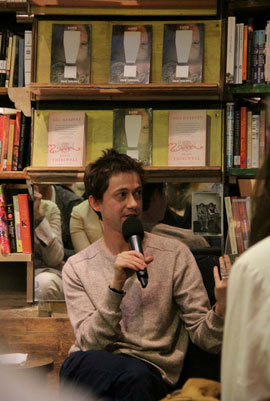
Adam Thirlwel reading

Q: You talk a lot about romance in your books, in Politics, and in your short story published in Granta, “The Cyrillic Alphabet,” which I found to be touchingly romantic. And so I was wondering how you feel about that. Do you consider yourself a romantic, are writers romantic by nature? Not necessarily in the lovey-dovey way.

AT: I do write a lot about romance, and the concept of romance. I don’t—oh that’s a horrible question…it’s true I’m very fascinated by romance, in different directions. I’m always interested in exaggeration of feeling, and trying to get feeling correct in descriptions. Romance is fascinating because it’s two things at once. Obviously there’s a truth to desire, a truth that desire creates, and at the same time it’s an exaggeration. Trying to be true to both the irony and the sincerity of it is something that interests me.

Oh, this is like therapy…

Q: You talk about detail of feeling, to amplify the notion of detail. Do you think there’s an ethical problem in writing about a time and a space that you don’t have direct access to? In so much detailing, is there an elusion of accuracy? For example, the setting of Kapow!…

AT: The setting was Cairo. But I did deliberately not name the place. That was for various reasons. One of them, precisely, to try to preserve this small area of pure imagination where it wouldn’t therefore be people saying “actually you can’t turn left on that street.”

Detail is a really fascinating thing. It’s the essence of a novel in some sense. The real interest for me in novels is not what people would call “realistic,” but how you make something convincing. The question of the convincing seems to be nothing to do with realistic or not, it’s whether you can somehow invent a world that feel coherent. It doesn’t necessarily have to correspond to the world other people are seeing, it purely has to be coherent on its own terms.

On the other hand, I sort of believe—and I don’t know if every writer must slightly believe this—that there is such a thing as a universal. Writing is often slightly at odds with theory. Where theory would say, you’re very much historicized and you’re very much in the moment and therefore you don’t have access barely to the person next to you, let alone something occurring in a completely different culture. And I think deep down I just can’t believe that.

There’s a passage I love in Diderot where, he suddenly breaks from a not very good story (it’s called “The Two Friends of Bourbonne”). And then suddenly there’s a little passage on the history of criticism which I’ve always loved where he basically starts defining what he calls the “historical tale”, what we’d call a realistic tale. And he simply says “All you need, if you look at a portrait, and it’s perfect, no one believes in it, but if you just add a wart, or a scar on their upper lip, immediately you know that they are real.” That seems to me to be true.

There’s a way—and this is the art of the novel, an art, a deep art—is inventing the details that convince. I don’t think there’s any reason why you shouldn’t be convincing. And I had fun with that in some of the digressions I read just there. I deliberately wanted the similes to be as far removed from the real context that I was describing. It was part of the game of saying “it doesn’t matter,” about that question of authenticity. So I compare a guy in Cairo, on the floor of an elevator, to a music stand in Detroit. That was deliberately trying to think of things as far removed as possible.

Q: In some of the Middle Eastern countries, they purposefully put in a flaw in the process of weaving a carpet, in order to give the carpet a soul.

AT: Yes. I’ve got so many flaws in this carpet, it is intensely soulful. But yeah, I think that’s a similar idea.

Q: Do you think at all about the stamina of the reader? For me, it would feel, if pages all of a sudden fell onto the floor, it’s like I just started this digression…I’ve made it all the way to the end, can I make it? Is it supposed to feel like wandering through Youtube, or like a note, an author’s note? Did you think about how we should take the digressions?

AT: It’s true that one of the things that was interesting about this book was that I was doing the writing in Microsoft Word, and I was just putting in bold bits that vaguely [digressed]. So, very easy for me to read. It was only when I was suddenly reading the galleys that I’d realized what I’d done. Or not what I’d done, but what this design studio had done.

I made them tone down quite a lot—I mean I would say this is about a third toned down from what they initially wanted, because I was very keen to make sure it was as readable as possible within the crazy constraints we’d invented. Hopefully the idea would be that you just kind of get used to it, that you’d get into a rhythm. The idea is that it speeds up. At the start, there’s no more than one a page, and they’re relatively simple, and it gradually gets wilder. So the nine page digression at the end, at that point, I suppose you’ve entirely lost it.

The point was that these are digressions, and I deliberately wanted that you could ignore all of them. You can read this and not look at any of these digressions. It was partly to compromise the reader. I like comprising readers very much. I like making them uncomfortable. And it was partly to make them think ‘Should I read or should I not, and why am I not, and why is this important, and should I be reading the whole thing.’ So it definitely wouldn’t bother me if you lost one digression.

Q: If this last book was such an unusual form, and Miss Herbert also was creating a form as it were, can you tell us a bit about this new book that you’re writing?

AT: The new one is going to be the most linear book I can manage. It’s just going to be pure plot. Pure plot is all I want.

{ 0 comments }

Troubadours

by HRM on June 16, 2012

Interview with Kyrie Kristmanson

Kyrie Kristmanson

Kyrie Kristmanson’s latest musical project, an interpretation of musical and lyrical manuscripts dating back to 12th century southern France composed by a compelling group of female songwriters known as les troubadours, will be premiered this Sunday, 17 June, at l’Église Notre Dame d’Espérance in Paris, France.

The Canadian singer-songwriter moved to France upon signing with the Paris-based label No Format! in 2010. Kristmanson’s latest album, Origin of Stars (2010), showcases her singular appeal through eleven terrific tracks that flirt with jazz, folk and classical styles but commit to none. Devotees of Kyrie’s music (we are legion: join us) will be quick to build a bridge between her earlier albums, such as Pagan Love (2008), and her budding interest in Medievalism, with folkloric and Biblical allusions abound. Her song The Holy, for example, shares an affinity with the story of the female troubadour singers, who were central figures in a renaissance in southern France until being persecuted during the Cathar heresy in the 12th and 13th centuries for their lyrical conflations of the sacred with the profane: We sing like traitors/ We sing and I pray to you/ We sing because it feels good/ We sing now because later we may lose.

Of course, Kyrie has always has always stuck out. I was first introduced to her at the Stan Rogers Folk Festival in Canso, Nova Scotia in 2008, where her sound and stage presence was as distinguishing and pronounced as her fur pillbox hat on a beaming Summer day. Indeed, Kristmanson has described the experience of growing up in the Canadian Prairies as being like the only vertical thing in a horizontal landscape, and I’ll borrow the metaphor to describe her oeuvre. We met in a bus station coffee shop in Montréal beneath a sign that read, “N’apportez aucune nourriture ni breuvage de l’exterieur,” sharing better croissants than the ones they sold.

-William Fitzpatrick


5 April, 2012
Café La Presse, Montréal

HER ROYAL MAJESTY: Your latest songs display an interest, in content and style, with the Medieval singers known as the Troubadours. When did you become drawn to this movement?

KYRIE KRISTMANSON: I moved to Ottawa [Canada] for university when I was seventeen and I studied the humanities, which is a four year program of philosophy, literature and religious studies. Each year moves forward in time. You start with myths and Biblical studies and you go all the way to modern philosophy and political thought.

It was during that time that I discovered the Medieval singers known as the Troubadours, and also the much lesser known female singers known as the trobairitz. And then I moved to France to tour for my Origin of Stars album, and there were lots of days when I was in Paris, so I decided to pursue this interest of mine.

I learned that during the twelfth and thirteenth centuries, the south of France experienced a kind of renaissance that was unparalleled in any other region. It was the development of courtly love poetry and singing. That sort of idealized woman, and specifically the aristocratic woman, was central to this movement. The troubadour would sing about this woman, and they would conflate her sometimes with Mary, but often it was on strictly profane terms.

It’s hard to know how widespread it was. We only have the names of about twenty writers. With the women, for example, it was only the aristocratic women who would write songs and poetry and it’s only the aristocratic women who are remembered as songwriters. So with the Troubadours, writing is much more representative of class. Were there more? Probably. But they couldn’t write down their lyrics. It’s hard to know why their songs weren’t transmitted.

HRM: What is it about this kind of writing that captured your interest?

KK: It’s really fascinating because this is the first source of profane music written by women, and because these songs are more controversial than even what the men were writing sometimes. It’s more personal.

As a result, the songs didn’t survive very well. Only one song has survived in its music and its text. The project that I’m working on with the French composer Vincent Ségal, who is also a cellist, is to reconstruct these melodies and to arrange them for string quartet and voice.

This is actually part of a second part of a project I’m working on in Canada, with a Canadian composer named Patrick Carrabré. He puts music to my poems for string quartet and voice.

The poems were written about this pilgrimage I made to the ruins of the castle where these women lived and wrote in the south of France. So this is going to be a continuation of that. We plan to complete that particular project by 2013.

HRM: Do you see an affinity between the profanity in the writing style of les troubadours and your own?

KK: At the time I became interested in les troubadours I was reading a lot about the tension between sacred and profane love. You see this in the work of a lot of Canadian composers. In Leonard Cohen, for instance, the tension between sacred and profane love is a reoccurring theme. And at that time, I was really interested in this question.

So I naturally saw that same tension in their repertoire because, in fact, the troubadour movement was linked to the Cathar heresy in the south of France. I don’t know much about the Cathar religion, other than that it is a dualistic religion and that it is linked to Manichaeism. The Troubadours come to an end at the time of the Albigensian Crusade, which was around 1250 AD, and which stamped out the Cathar heresy in a brutally violent way and sent all the Troubadours running to Spain and Italy. It was effectively the end of that poetic flowering.

A lot of people have proposed that the Troubadours were Cathars themselves, and that there are coded metaphors in theirs songs for this movement. I don’t think that’s true.

What is true is that they attached themselves to heretical courts. The feudal lord would often attach themselves to a court, and they would be the kind of composer-in-residence for that court who would sing about the deeds of the lord to increase his notoriety. A patron and a protector. As soon as their patrons and protectors were brought to ruin, they had to flee. And that was the end of it.

The really ironic part of it was that crusade was lead by a former troubadour himself, a troubadour turned fervent religious type.

There is so much mystery in that particular repertoire because we know so little about the composers. About the context really. Even the songs themselves were written down one hundred to one hundred and fifty years after they were composed. They were passed down through the oral tradition. As it died out scribes would write them into manuscripts so that they wouldn’t be forgotten altogether.

Kyrie Kristmanson

HRM: When you interpret these manuscripts into song, what is the level of collaboration you have with them?

KK: In that repertoire there is a lot of room for collaboration.

With a piece of classical music, for example, your options for inserting yourself into it are much more constrained. But with this repertoire, since it’s so schematic to begin with, there is a lot of room for the interpreter for collaboration.

Up until six months to a year ago, my interest has really been in the way they composed, and the context in which they composed and what they wrote about, and also their cultural role, and their improbability. I was really inspired by them. I was calling them my musical ancestors.

There was something very direct and raw about their lyrics that kind of reminded me of like an early PJ Harvey [laughs].

HRM: Care to illustrate this through an example?

KK: Sure. One song goes,

Let me hold that noble knight
in my bare arms tonight. 

If only as his pillow
I know I could make him so high. 

He is in me more and more
Than Flor was in Blancheflor…

She offers to be his pillow. At another point, she says something like, Let me make it clear to you, my friend, that I would rather hold you than my husband. Only if you swear to me that you will do whatever I ask you to. And then, I know you’re not a coward. When will I hold you in my power?

It’s sort of a strange mix of putting herself beneath him, but always reestablishing her power. There’s a lot of language that is reminiscent of odes of fidelity.

And there is a political angle to the lyrics as well. I’m not the first to note that. There’s a really interesting American writer called Frederic L. Cheyette who writes about the female Troubadours and shows how a lot of this language in fact comes from odes of fidelity.

That makes for quite a tense piece of music.

HRM: You’ve mentioned in live performances that you’re in the early stages of composing an opera of sorts, and even your earlier songs take the form of dialogue. Your song, The Sea Song, for example, can be described as a dialogue with the ocean.

KK: More recently that has been something that’s emerging in my songwriting. I don’t know why that is. I guess I really love the faculty of imagination. That’s always been a realm in which I’ve been very comfortable. And sometimes I think imagined experiences are just as affecting or more affecting than my real experiences.

So I think that’s just a realm that I’m more comfortable in in my writing. Because every song is autobiographical, in effect. Even if you’re writing about someone else, you’re writing about yourself.

And I like that complex I, and that complex you. When you’re referring to someone else you’re referring to yourself too. It might be a way to protect yourself, because there’s something very confessional about songwriting. I don’t consider myself a confessional songwriter per se, although I admire Joni Mitchell, the confessional songwriter par excellence.

It is kind of a mechanism of protection as well.

HRM: Having grown up in different parts of Canada, how has moving to France made you feel?

KK: Moving to France was quite lonely at first because I didn’t know anyone apart from my label, No Format. But loneliness can be quite useful. That’s when I delved into this interest of mine. When I wasn’t playing I had days I could really pursue that.

That being said, I love living in France, but I will continue to live in some way in Canada. Always, I hope.

In preparation of her next musical project  —an unexpected collaboration with French composer and cellist Vincent Ségal— Kyrie Kristmanson will premiere in France two repertoires: first she will play a selection of songs from her upcoming album and then she will be joined by the Quatuor Van Kuijk to perform three song cycles prepared for her by Canadian composer Patrick Carrabré.

En pleine préparation de son prochain projet musical -une collaboration inattendue avec Vincent Ségal-, Kyrie nous présentera un concert en deux partis : en solo à la guitare, puis rejointe par le Quatuor à cordes Van Kuijk, pour un répertoire de ses compositions encore inédites.  

Les Saisons de la Roquette presents Kyrie Kristmanson 
June 17th, 17:00H
Église Notre Dame d’Espérance
47 rue de la Roquette, Paris 75011


{ 0 comments }

ISSN: 2116 34X