That man sounds like the devil

by HRM on October 26, 2011

Frank Znort Quartet at Blå in Oslo, 09.10.2011

“I tried everything, from parachuting to bungee jumping, but nothing gives me such a kick, such a liberation like standing here, on the stage, making music.“ Gard walks away from me. He is nicely dressed in a black suit, a tie, leather shoes.

Gard is one of the members of the Frank Znort Quartet, a group of musicians playing every Sunday in Oslo’s notorious nightclub called Blå. It is a peculiar, slightly mysterious place and probably one of the most alternative locations of Oslo’s nightlife scene. Lying right at the border of the river Aker Selva, hidden between trees and surrounded by a collection of bizarre stone sculptures, Blå is a centre for music and literature in Norway’s capital.

Franz Znort QuartetIt is here that the Frank Znort Quartet plays their mixture of funk, jazz, soul and reggae every week. And just as their music style is hard to pin down, so are the musicians themselves. Whether formally dressed or in a Hawaiian shirt, whether in outdoor sportswear or a flower dress, whether Norwegian or any other nationality, it is an incredibly colourful, a varied and unconventional combination of artists. There is Seff, the piano player, hidden behind his dark sunglasses while playing; there is Sidney with his haunting soul voice and also Willy, always somehow ducked but moving smoothly to the sound of his tambourine.

“We started off with just four of us, doing small jam sessions from time to time. Now we are about 19 or 20 people, I don’t even count anymore.“ Arne is one of the founders of the band, prefers to sit slightly sideways on a tiny chair while singing with closed eyes and a hoarse voice “which makes him sound like the devil“, as one of the spectators remarks.

“We don’t care about professional music education here. I just went backstage with my guitar once, I auditioned a little bit and here I am,“Gard laughs.

The only woman in the Quartet is Anette, her hair cut short in a blond bob, wearing a colourful, snug dress and singing of love, money and men. Bedroom eyes, delicate gestures, gracious moves. I hear a voice from someone in the audience: “I love that song and I love how that woman sings it. “

The Frank Znort Quartet offers a stage, a possibility, a moment for all of them, for all of those original, unique people; this seemingly random collection of personalities and lifestyles being on stage together and finding a common language in their music. “It is not about profit here. If we make money we just use it to make our ensemble even better, to make even better music, to find even greater fulfillment,“ says Arne while watching one of his colleagues perform: “We also created two music schools in Africa and if we make some money we use it to buy some instruments to ship them over there or to buy plane tickets so that the kids from there can come and play with us here.“

So every Sunday evening they all come here, a man with a devil’s voice, a woman in a flower dress, a professional saxophonist, an elegant transsexual, a dynamic drummer, a Brazilian singer. They find liberation and energy, they get carried away and drag the audience right along.

“We just recorded an album at the Abbey Road Studios in London. And then it hit me – this is working and I am being part of it! That gives you such a rush of self-esteem,“ Sidney explains. “Really it is nice… but after all, that is not why we are doing it,“ he adds before jumping on stage.

So as long as they have a stage to play jauntily, to sing jazz and dance Tango, untroubled and open, nothing else seems to matter. At least not on a Sunday night. Or as Gard sums it up: “It’s such a horrible, disgusting weather today in Oslo. But in here, there’s always sun.“

{ 0 comments }
In Matthias Schleifer’s Studio, by Franziska Knupper

A handbag with sharp teeth lays on the floor, several miniature Eiffel towers stick out of a boxing glove and the sound of a single saxophone wafts in from next door – we are at the Cité Internationale des Arts Paris in Martin Schleifer’s atelier, his home.

Matthias Schleifer

The Cité Internationale des Arts regularly invites talented artists, composers and writers from all over the world to the rue de l’Hôtel de Ville, to Paris, where they are provided with space to live and work. While the neighbor next door is playing a never-ending loop of scales on his saxophone, echoing from the walls of the inner courtyard, Matthias Schleifer, a German artist from Karlsruhe, kindly opens the doors of his atelier and invites us to his world and creations. His creations include these threatening handbags and also his collections of three year-old pretzel sticks, a baguette with a hinge-joint, and the head of a stuffed dog.

Matthias Schleifer

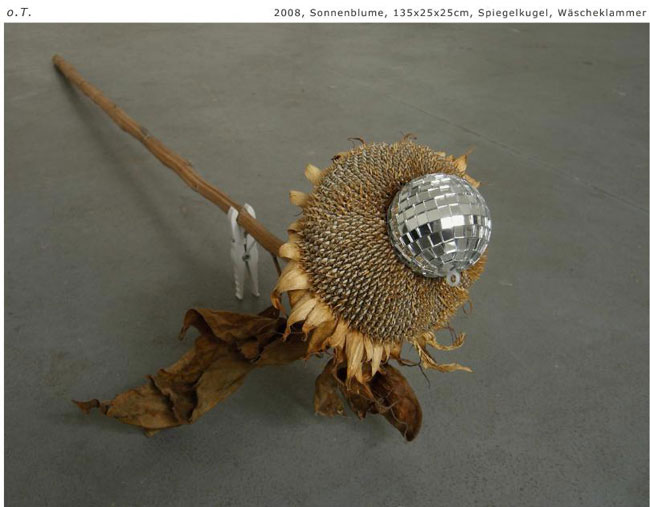
The notorious puppy head, for example, finds his new home on the top of a drumpad, his fluffy pink hair not really matching his new task. A plastic mask of a human face takes a nap on a mattress found in the streets of Paris, a broken vinyl disc record is fixed with a zipper and in every corner of this place newspaper cuttings of naked women and numerous bottles of glitter nail polish just seem to be piling up. “But no worries, that’s not for personal use, everything here is just for art’s sake,” he laughs.

Matthias Schleifer

Currently, Shleifer is developing a series of photographs taken from unfamiliar angles, playing with visual perceptions and forcing us to overcome the natural, the conventional impression of the objects being displayed.

“I like the moment when you are confronted with a certain senselessness, perplexity, absurdity”, he says when looking at his pictures of scooters on wheels of bread, of toilet paper, of mirror balls. What we consider an important of a certain object, of a certain perspective, suddenly appears outworn and antiquated when manipulated by Schleifer. Forever rendering banalities into art, he inspires everyday objects to become something more. In one of my favourite photos, Schleifer makes holes in a plastic bag and puts the bag in front of the camera. What’s left is a shattered image of the world, a swift glimpse of the surroundings behind. “I want a reaction of confusion, of being overwhelmed by what you see, by what you’re confronted with. I don’t particularly want the spectator to understand, only to guess.”

Matthias Schleifer

Matthias Schleifer

Some of his pictures seem arranged, sometimes static, even though coincidence plays a big part in his achieving: ”Sometimes I find certain things just as they are and just need to make a tiny change in order to give it that absurd, surrealistic look.”, he says while having coffee, cherry pie and cigarettes. In his images, I realize that reality becomes negotiable.

Matthias Schleifer

“Nevertheless, I have certain projects where everything has to be in his place, where I spent hours arranging every detail before even grabbing the camera,” he adds, referring to several of his earlier works such as the “pretzel stick storm,” where he arranged millions of pretzel sticks like tiny needles around a decorated Christmas tree.

His coin circles develop this same theme: he laid out a perfect, ideal shape of a circle of coins in a pedestrian area only not find them gone the next day. “I think I struggle to explain my own work even though I know exactly what I want and why I do it. But I don’t know if words are actually the right tool for defining that, for defining art.”

All works by Matthias Schleifer.

{ 0 comments }

Interview with Joachim Trier, by Franziska Knupper

Just one week ago I returned to my hometown, a place in Western Germany, a place with family, memories, past. A place where you immediately become the former person you have been when you left, no matter how much time you spent somewhere else. And that was when the name Joachim Trier popped up more frequently in my mind than ever before.

The second long feature film of the Norwegian director “Oslo, August 31st” has been in movie theaters here for a couple of weeks. And again, Trier (yes, he is a cousin of the Danish Lars von Trier) tackles fundamental subjects of human identity such as the connection or the identification with a place, with a region or the fact that you always take yourself with you, wherever you go.

Oslo“I myself grew up in Oslo and my last two films take place here,” Trier says. “The beauty of that place is not very obvious, you have to look for it,” he adds while taking a sip of his coffee. We sit outside a café in Norway’s capital, it is already freezing cold; it is just the middle of October. “This is the place where I lived when I was young, where I have my roots and the most preconceptions, either good or bad. I think it is very destructive to try to erase your memory and sooner or later you have to accept that.”

In his latest movie, the main character also has this experience when he entering his old life after coming out of rehabilitation: “Well actually it is not about rehab or addiction. It is about what follows afterwards and about re-entering society,” Trier corrects me.

The protagonist thus faces all those different expectations and pressures of human community, emerging from all sides. Such as for example the obligation to be at a certain point at a certain age in life and not regretting what you have done before or what you might have missed out on. “Contrary to my first movie [Reprise] this one also deals a lot with age, with the feeling of inferiority to the others who seem to have succeeded more.”

There is a point in the movie when one of the characters says to the protagonist “You have great friends, you have family, get a grip!” It is a point when suddenly the past is stronger than the present, when regrets paralyze you and make you doubt yourself in your current situation. “He has all options lying in front of him, he could lead what we call a “proper life” but he somehow lost his way,” Trier sums it up, referring to our generation with all possibilities but no orientation.

Joachim

For the second time Trier works with the actor Anders Danielsen Lie, for the second time these two approach the human mind and human nature. “Working with Anders is very fulfilling in sense that he inspires me. After doing Reprise I knew I wanted to do another movie with him.”

But even though the team and the subject might be similar in these two movies, the style is not at all: “I wanted to create a very linear story line this time. All events are in chronological order. In my last movie it was quite the opposite. There I used voice-over, flashbacks, change of place and time, a mixture of reality and the thoughts.“

Now we are following the protagonist just for one day, through the city of Oslo, Trier’s hometown. We mingle at parties, we sit lonesome on a bench, we jump into a river. We experience it all at the same time – melancholy, longing and zest for life.

{ Comments on this entry are closed }

The Family Way

by HRM on October 17, 2011

Flash fiction by Lacey Haynes
Photo by L. Alexandra Kappel

Photo by L. Alexandra Kappel

It was worse than they both thought. Their matching vests, ruined. The flood had licked through the carefully stacked cardboard boxes. Their cellar now filled with water coloured by the things it had destroyed. All of Nana’s tiger portraits done in meticulous needle-point stood bloated, colour-bleeding. Brown bear, a single eyed teddy found on the property decades ago, drowned and limp.

Having lived in that house together for fifty odd years, the twins had seen their share of weather. But even the ice storm of ’79, fallen power lines having decapitated baby Jesus in the manger out front (the little head found later in the gummy mouth of the neighbourhood mutt) couldn’t compete. This weather was different because it had moved inside. It veined its way into their foundation, seeped straight through like ghost does a wall. And now – lord help them – the vests were ruined. Their His and Hers patchwork vests that Mumsy had made when she became fascinated by deconstruction. She had never had an interest in anything before, but for about seven weeks in ’63 she tore clothing apart and reassembled it. Leather patches scattered about their home, their lives existing under a layer of skin. Shortly after Daddy had left for the ground she became obsessed: first his old jackets and leather riders, then pieces from Goodwill. Anything made of tanned skin, she would cut and stitch and try to make new again.

Now the vests hung like swollen animal tongues from a soggy brown box. This was the last straw. The twins had seen their share of troubles: their messy history started in this very house one hundred years ago. Mumsy and Daddy both born under this very roof. Now ankle deep in murky flood water, the eldest pulled each vest gingerly from its sloppy grave. Dripping with colour and stretching grotesquely, the vests became beastly, but neither hesitated to pull the sleeveless treasures on over their house clothes. Mumsy had made them big, so they’d always fit. Fit right until the end.

Hanging from the beams above were two ropes, just like before. Daddy first, then Mumsy a few years later. The twins smiled tight encouragements to one another. The youngest, she smiled at brown bear too, as he floated face down in the flood water. They each stepped onto their own chairs, their bodies heavy in the skins of animals who had come and gone before. The ropes were thick and prickly on their His and Hers necks. When each stepped forward it was an echo, but with no little ones to pack away the bones this time. Their feet first churned lazily, kicking up colours and memories in the stagnant water, before finally coming to rest in the family way.

{ 0 comments }

Amphibrachic Speakers

by HRM on October 14, 2011

A Look at Leonard Cohen’s “Famous Blue Raincoat” by Michael Follow

CohenAfter Leonard Cohen declared bankruptcy, he began appearing in public and offering performances. On October 18th, he is releasing the Complete Studio Albums Collection.

Forty years ago, he released “Famous Blue Raincoat.” The song is about a love triangle between two men and a woman; the speaker’s wife has left him temporarily for another man, but she has since returned. The song is still notable for its meter: amphibrachic tetrameter.

An amphibrach is a foot comprised of a stressed syllable set between two unstressed syllables. In this song, each line has four feet: four amphibrachs. The amphibrachic foot visually represents the topic—but not the subject—of the song: one woman between two men. When you hear the line, the meter sounds lilting and shell shocked, like a voicemail left by a hostage taker, or the hostage.

The song is also notable for the way Cohen uses rhythm to emphasize the meter. The lines are slow and sometimes spoken rather than sung. Sometimes there is complete silence, as the pauses in the instruments and pauses in the lyrics coincide. The pauses, the lengthy unstressed syllables, the sudden stressed syllables, and the slow rhythm, are all part of the speaker’s identity: an emotionally deadened lover, a possible psychopath.

This slow pronunciation, the rhythm, is as important as the meter. If the meter reflects the topic (the lovers’ triangle) then the rhythm suggests the subject (the mentality and identity of the speaker).  Listen to the cover Tori Amos recorded over 20 years later. She follows the same lilting amphibrachic tetrameter, but speeds the rhythm and adds elaborate flourishes, removing the speaker’s personality from the song. A line that takes almost ten seconds for Cohen to read takes less than five seconds for Amos to sing. In Amos’s version, the speaker is not deadened: he’s dead.  In Cohen’s version, the speaker is a man writing a letter to his wife’s ex-lover; in Amos’s version, the speaker is Tori Amos.

Which is another way of saying that Cohen’s best tribute is his tribute to himself: the Collection released today—and not the album recorded in the 90s with Amos.

The subject in the original version is so real that the speaker’s identity is separate from Cohen’s, even when Cohen signed the song lyrics himself.

{ 0 comments }

ISSN: 2116 34X