An Interview With Caroline Cox

by HRM on October 7, 2011

by Rachel Ton That

Last Sunday I was invited last minute to attend a gallery opening in Brooklyn. The gallery space, called FiveMyles, is unassumingly tucked away on a quiet street close to the Brooklyn Museum with only a plain façade and discreet sign to indicate the entrance. Inside, however, the discovery felt like a revelation: the exhibit featured several sculptural installations by Caroline Cox and a series of paintings by C. Michael Norton. Cox’s delicate sculptures, constructed from nylon fishing line and plastic mesh, were fascinating, ethereal and all the more exquisite to have come from such humble materials. When a mutual acquaintance introduced us I took the opportunity to ask her for an interview.

Spin

Spin (food packaging mesh, acrylic balls, monofilament)

First, could you tell me about some of your inspirations?
When I was around six years old, my Grandmother started teaching me how to sew. I remember being amazed at how flat, pliable fabric could be transformed into a hollow form, and how the fabric was made from thin woven threads. In private I made small, strange weavings by poking straight pins into the upholstered furniture and winding thread around and through them curving in every direction, not straight or in a grid. I remember being confused as to why I was doing this and always took them apart immediately after they were done. My fascination with folding, weaving, stitching and knotting was reinforced during a field trip in elementary school to Sutter’s Fort where I first encountered the art and everyday objects made by Native Americans. Looking back they were probably the Nisenan Maidu, who had inhabited the area where I was living, outside of Sacramento, long before Europeans came. I observed that all of their basketry, clothes and decorative items were in some way woven, tied or sewn.

While I was in elementary school I spent a large amount of unstructured time wandering in nature, speculating that indentations in rocks were where Native Americans had ground their acorns, and just looking at things, observing how wild plants grew together in a tangle. I could immerse myself in slowed down time, the subtle nuances of changing light, and the soundtrack of bugs. Much later I learned about ideas of evolution; I was amazed and inspired by the way these concepts connected all things into a constantly churning, changing and responsive mix. The organic forms I once observed were blown apart and put back together in a way that seemingly no one could fully understand.

Around this time I also became aware of improvisation through the music of Thelonious Monk and other artists. Later I moved to NYC and became involved in the downtown experimental music scene that John Zorn was influential in, and I played in an improv noise band, The Chairs. The unstructured immediacy of this music transformed my visual art and how I thought about content.

Loopng

Looping, 5" x 7", monofilament

Do you intentionally reference marine life, or is this coincidental in your current exhibition?
I make my work without sketches or pre-planning – it typically goes through numerous permutations. I set the piece in motion focusing on the materials that I use, ignoring content. I want the piece to come into being through the process. My interests are eclectic and I incorporate diverse materials, objects and ideas into my installations. While making this piece I was particularly interested in a wide range of natural structures: from warping of the space/time fabric to diatoms to microscopic structures of mold. I trusted that these interests would surface during the process of making the piece and I didn’t consciously introduce them. Viewers at the opening of Spin – the title of this current series of mine on exhibit at FiveMyles – related a wide range of associations or references that ranged from marine life to black holes, and molecules to lace.

While the mesh components can be a source of multiple associations and references, during the construction of the installation I approached them as experiments in the transformation of the material and its tubular structure. The mesh comes as one very long condensed tube wrapped on a large spool. The individual components were unique investigations into possible variations and mutations, much as I imagined would happen during the natural process of evolution.
What do you feel like this current work represents for you? Do you think this is a new incarnation of an old idea, a turning point, or an entirely new theme?

One unique aspect of Spin compared to my other work is that the mesh components are more self-contained, even though they are unified by their material and how they’re put together. They’re constructed from sections pinned together with roller picks and then hand-sewn with monofilament. Because they are porous and hollow the surface becomes the structure in a more pronounced way than in previous pieces.

I’ve always used photography as a way to get a different take on my work, I’m interested in seeing the work flat with its shadows. The Spin images (not included in the installation) that I’ve shot of the mesh components moving at slow speeds look more like misshapen tornados. The internal structures are as accessible as the surface is to the camera and the way these inner chambers read is unexpected.

My work has always been static before with the exception of ‘Scuse Me While I Kiss The Sky which unintentionally was set in motion by the gallery’s enormous heater. This accidental kinetic installation has stuck in my mind and when I saw how easily the light components of Spin moved and what it brought to the piece, I decided to incorporate movement into the work.

Finally, what was your experience at FiveMyles? How did you work with the curator to put the exhibit together?
FiveMyles is a very unique gallery because of the way Hanne Tierney, who is also a performance artist, runs it. Hanne integrates the gallery into the neighborhood and has an open door policy. The people in the neighborhood work at the gallery and she is an advocate for her neighbors in many ways – you can’t spend too much time there without getting caught up in it. I met Hanne several years ago through Marianne Griffiths, who founded and ran Sculpture Center when it was in Manhattan. Many of my contemporaries have shown at FiveMyles; it has been in existence for 12 years. Last year Hanne contacted me to set up a studio visit and later invited me to do an exhibition. When it came close to the show we met at the gallery and very casually bounced ideas around and it was quite easy to come up with a plan.

Spin (2011) was made for FiveMyles’ unique exhibition space, with its grey walls and floor. I knew the white components would not disappear as they were hung off the ground and got closer to the ceiling as they would in a space with white walls; so I took this opportunity to develop a piece where the exhibition space played down the figure ground distinction and viewers could feel more submerged in the work.

My work is physically transparent, so I’m always concerned about the context that I put it in. Fortunately, for the most part, viewers are pretty good at focusing in on what they want to see.

Caroline Cox is an artist living and working in New York City. More of her work can be found at carolinecox.com

{ 0 comments }
Gerhard Richter: the malevolent deity

by HRM on October 3, 2011

Review of the exhibition at the Marian Goodman gallery, Paris

gerhard-richter

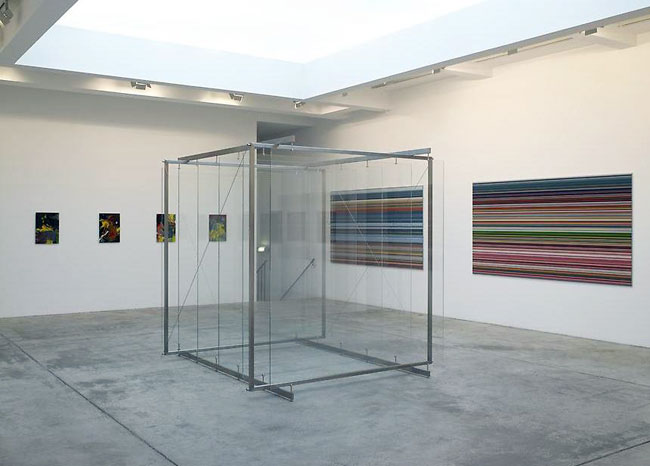
While the elite of the European art scene mingle in the inner courtyard of the Marian Goodman gallery on the Rue du Temple, sipping champagne and swapping business cards, the artist himself has already taken off. After signing a reasonable amount of books, hastily glimpsing at his work and smiling a couple of times into the cameras of the art paparazzi, Gerhard Richter wisely decided to escape. He left behind a somewhat hodgepodge collection of digital prints and colored glass plates, punctuated with on enormous glass sculpture that seems to belong to another show – another era, even – altogether.

gerhard-richter-by-patrick-chelli

Photo by Patrick Chelli

The only time I succeed at engaging him in conversation, Gerhard and I talk about German beer. He is articulate on this subject.

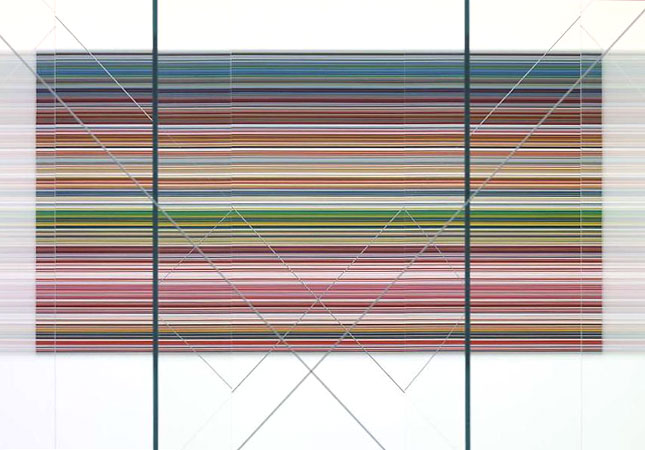
Wandering from one piece to the other, looking from a distance, frowning, then slowly approaching the work – we are proper arty folk, you know – the viewer is forced from one extreme to another. Richter’s new work wavers between tender softness and geometrical abstraction. His digital prints called “Strip” are visually confusing despite being an incarnation of structure, balance and control: the images remind me of those Magic Eye images you might have played with as a child, your nose almost glued to the paper and then slowly moving away from it, waiting for the secretly hidden patterns to reveal. However, if you try that with Richter’s work, you will be disappointed. It is a bright coloured strip and it stays a bright coloured strip. No patterns or revelations are revealed.

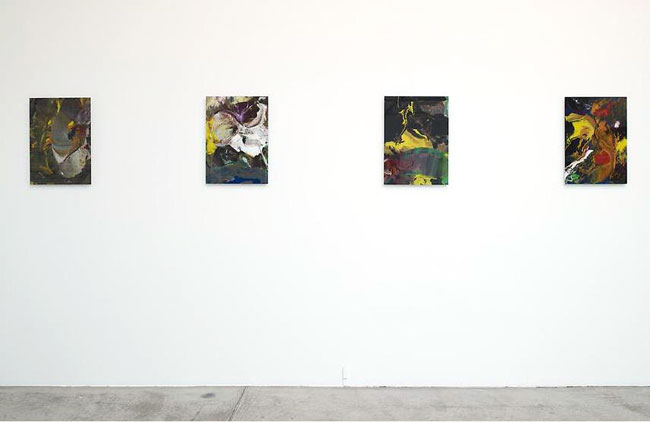
Following the digital prints, the viewer is confronted with blobs of paint floating and merging on glass plates. The colours are sober, tender; the whole thing is not far off from a batik print. I get the feeling that something is missing from the image, though; that sense of completion that usually comes from Richter’s work is absent here. Those who felt attacked by the digital art, however, could find comfort in these consoling pictures, and this balance gives the exhibition a sense of harmony, if nothing else.

gerhard-richter

The final piece, Richter’s glass sculpture, is a transparent shelter that reflects every color in the room. When the visitors rotate around this curious object (desperately looking for an ashtray in this noble establishment), they resemble pilgrims praying to a holy relic. For even if Gerhard Richter’s new collection of work is a bit incoherent and incomplete, he will always remain a sort of demigod.

gerhard-richter

gerhard-richter

All photos (except when otherwise noted) are from the Marian Goodman website. The exhibition runs from September 23, 2011 – November 03, 2011

{ 0 comments }

Cecile

by HRM on October 3, 2011

Photography by Emma Klara

Emma-Klara is a photographer and musician currently living in Leksand, Sweden.

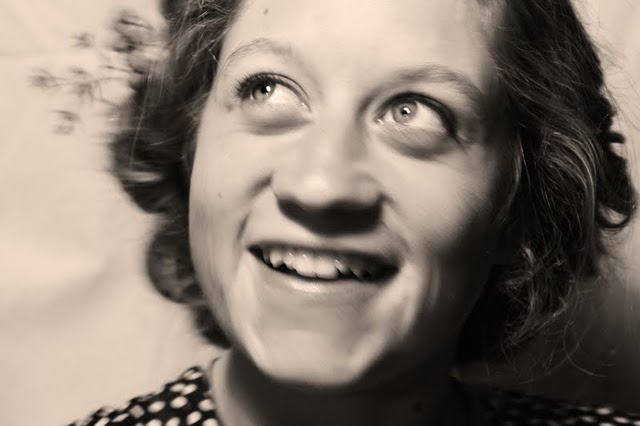
Cécile i sommarskrud

Emma Klara

I love your smile

{ 0 comments }

Reve Generale

by HRM on September 28, 2011

Photography by Emma-Klara Sandberg

Emma-Klara is a photographer and musician currently living in Leksand, Sweden.

reve general

rêve generale

{ 0 comments }

by Lendl Barcelos

We witness the beginnings of a deep relationship between time and the melting of candles. It used to be that night or cloudy weather – moments where the movement of the sun or its shadows could not be measured – made timekeeping difficult. In response to this, the candle clock was created. The instrument is simple: a lit candle and markings of consistent distance. As the candle burns and reduces in its size, duration is measured.

Turning this process on its side, Ethan Frederick Greene’s piece ‘For Candles’ (2011) uses the melted wax dripping off four horizontal candles to mark the passage of time with sound. One of the four candles, dubbed the “maestro candle”, does this literally by controlling the tempo of the piece. Meanwhile, the other three candles become semi-autonomous performers as they incite sound impulses with every drip which then expands and develops through Max/MSP processing.

Lendl: Firstly, can you describe the generation of this piece?

Ethan Frederick Greene: I had a pretty clear idea of the arc of the piece from the start: from drip sounds alone, to rhythmic patter, to pitched chorale. I wanted the listener to first focus on the individual drip sounds, then to hear the candles’ patterns with respect to each other, and finally to hear those patterns take on elements of pitch and harmony. So the piece takes, roughly, a thesis-antithesis-synthesis course. Of course, this is all subject to the whims of the candles. Though they generally produce a metronomic pattern of dripping, sometimes they’re a little less predictable, and—as happened in this particular performance—they get less and less predictable as they burn down. However, the rates of delay and harmonic progression are affected only by the first candle, so the unpredictability is tamped down somewhat. And at the same time, I am at the software adjusting feedback rates, so there is some control I can assert.

L: There are multiple sections that can be heard in the piece. They shift between an “electro-acoustic” or “sound art” territory and a more harmonically driven music territory. Can you describe your interest in these disparate areas of aural practise and what you achieved in ‘For Candles’ more specifically?

EFG: I want the piece to feel like it progresses organically from raw sound—the unaffected phenomenon of candles dripping wax—to compositional artifice. That is, I hope the listener will begin to notice the subtle differences between individual drips and rates of dripping at the outset (this is much easier to do when the piece is in four channels), to hear the candles as not just inanimate objects, but as performers in an ensemble. Once I feel this has become apparent, I begin to process the sounds. It starts with reverb, which is the first move toward a more “electro-acoustic” sound world, and continues on to delay lines. Once the delay reaches full saturation, I introduce pitch, which is the real tipping point—the revelation that there is another force (me) at work.

Ethan Frederick Greene

L: Besides composing for inanimate performers (candles) you also compose works for animate performers, do you approach these two differently? How much do the performers influence your work during the conception and creation of a piece?

EFG: In most of my pieces, no matter who or what is to perform, I start from harmony and rhythm. In the case of this piece, the rhythm was largely aleatoric, but I wrote the candles’ chord progression out in full before I started on any of the electronics. The same often happens when I’m writing for ensembles of humans. I’ll come up with some pattern of pitches or rhythms in my head or at the piano, and everything will grow to and from that. Once the central germ is established, I take a lot of cues from the performers—what it looks like when they play, how difficult it will be to enact a certain idea, if they can be as expressive or inexpressive (since expressiveness is not always the goal) as the music I’m hearing demands. In this piece, I’m a performer alongside the candles, so I like to think that I can answer all of my demands.

For Candles

L: Dance is intimately related to music. As a composer, what is your relationship to dance? Is there a particular piece or style of music that you can’t help but dance to?

EFG: Interestingly enough, ‘For Candles’ was first performed last year with an accompanying choreography… But as to the question, I have a somewhat complicated relationship with dance. I grew up listening to a lot of hip-hop—Nas’ first album, Illmatic, remains one of my favourite albums—and when I started composing, I tried to blend Charles Mingus with Steve Reich in a sort of Third Stream style of music. So you can see there’s a lot of rhythm and pulse in there. I guess I love to dance in my heart, but it’s always sort of made me uncomfortable to do it out in the world. Maybe it brings me back to my pre-teen years and all the Bar Mitzvahs I went to. That is not a good feeling to relive. So unless you count bobbing my head, I’m not much of a dancer, but I would love to compose more for dance—maybe even write a full ballet one day.

L: On your website you are listed as a “composer, sound designer, and friend”…can we be friends?

EFH: Lendl, even now we are friends. And we shall be for some time.

More on Ethan’s website: ethangreene.org

{ 0 comments }

ISSN: 2116 34X