Made in Britain

by HRM on December 8, 2011

Interview with Gavin James Bower, by Lauren Elkin
Gavin James Bower, photo by James Harrison

Gavin James Bower, photo by James Harrison

A few years ago, Gavin James Bower made quite a noise in the English literary world with his first novel Dazed & Aroused, based largely on his experiences in the fashion world; in The Independent, Lee Rourke called it “an insightful debut from a novelist who already shows an ability to cut through the hype and reveal the dark heart of everyday life.” Then, this year, he published his second novel, Made in Britain, which similarly draws from a milieu Bower knows well: teenage life in an average town in the north of England, which Bower simply refers to as Every Town. Hayley, Charlie, and Russell take turns narrating their stories, as they hurdle forward towards disillusioned adulthood, their voices clashing and clattering over each other in an attempt to get out: out of their town, out of their lives, out of the book itself. The Guardian described the novel as “visceral”: “Showing us as it does a world of closed factories and stinking canals, of sex in the school loos, of knives and drugs and moral and economic disintegration, this novel could have been one enormous cliché. It isn’t, though. While not excusing, or attempting to excuse, its protagonists, it manages to explain and humanise them.” Bower himself great up in Burnley, in Lancashire. Here, he tells us about growing up in the north, method writing, and why he’d never write a book in the third person.

Can you tell us a bit about the genesis of your new novel, Made in Britain? There’s a movie, right? Which I haven’t seen.
The eponymous film’s by Alan Clarke, starring Tim Roth, and was made in 1982 – the year I was born. There’s not much in the way of similarities, beyond it being about disaffected youth – whatever that is. The late Fred Dibnah, a legendary steeplejack, had a more recent TV series of the same name anyway. That’s more of an influence, I’d say.

Made in BritainThere’s an obvious slight on the policies of de-industrialisation in my choice of title, but I didn’t spend much time thinking about that. It was serendipity really, my being up north for one winter, the book deal for Dazed & Aroused having been signed, and writing about growing up in a post-industrial ‘every town’. That, plus I talked to my dad a lot about Burnley’s industrial past. Some of the best lines – ‘business has gone for a burton’, for instance – are down to him.

How do you see Made in Britain fitting in alongside other representations of lost English youth (from Look Back in Anger to “Skins”)?
They’re all about thirty in Look Back in Anger, right? And Skins is about pills and generally being middle class, I think.

In all seriousness I didn’t write MiB to fit alongside other representations of ‘lost English youth’; I wrote it because I struggled to fit in growing up, and only recently felt able to write about that time in my life, and the experience of living in a place where you don’t feel like you belong. It demanded distance and time, and is a love-hate relationship I wanted to tackle. I think anyone growing up somewhere like that, anyone who struggled to fit in and belong, can empathise. They don’t have to be Skins fans, because I’m certainly not.

Is Britain broken?
I’ll let Charlie [a character in Made in Britain] take this on…

‘The match is on and we’re all sitting in Lee’s front garden, which is really just a few square feet of flags. He’s put the TV on top of an old Ford Escort, the extension cord stretching through the house. There’s music blaring from inside – that mind-numbing happy hardcore shit – and it must look a bit daft to anyone not from round ’ere, but it’s open-air theatre to us.

I keep seeing all that stuff about those murders on the news, and hearing how we’re not right round ’ere – that we’re the underclass and the reason Britain’s broken. Well y’know what, I think, finishing my beer. Fuck ’em.’

Your first novel, Dazed & Aroused, was based on your experiences as a model; to what extent is this new book based on your experiences growing up in the North?
D&A
was really about landing in a city like London, and finding it hard to empathise – to be happy, too. Modelling just provided a backdrop.

With MiB my whole childhood informed the writing, but I didn’t want to make it a 90s novel. It needed to be contemporary, manipulated through the eyes of someone no longer of age and set in the here and now. The plot’s almost entirely made up, save for a few allusions to real life incidents – some comical (the Gordon the Gopher money shot, for example), and some not so (the headless bodies).

Can you tell me about your affinity for writing in the first person? What does it do for your work that the third person doesn’t?
There’s an obvious immediacy to it that appeals to me, because I want urgency and prejudice and paranoia and alienation to infuse the writing – and the character’s narrative to be taken as is. I don’t feel comfortable writing from the perspective of an omniscient character that’s only partially revealed to the reader, even though there are clear opportunities for landscaping denied, on one level, to a first person narrative. With the latter there’s a vulnerability available, but also the chance to get under the skin of characters – to become them. It’s draining and demanding, but rewarding too. Which is why I write that way.

You shaved your head not long ago. Claude Cahun, who is the subject of your next book, also shaved her head. Did you do it out of an attempt to get closer to your subject? How’s that going?
There was a touch of the meltdowns about my decision to cut all my hair off, as I was going through a transitional period in my life and wanted to exert some semblance of control over it.

Still, I reckon I’m the only novelist in the world to describe myself as a method writer and actually mean it.

How did you get interested in Cahun?
One of my first pieces of journalism, for FLUX, was on a small exhibition featuring her work. I did a lot of research, being a bit green and wanting to do a good job, and got totally immersed in the history of her life and art. I was hooked, and have been a fanboy ever since. I’m not an expert like Leperlier. I’m a fan.

There’s such variety in your subject matter. Tell me, is there any kind of book you wouldn’t write?
I wouldn’t write a book in the third person.

You’re going to be spending some time in Paris early next year. What are you planning to do while you’re here, besides write?
I’m writing this book on Claude Cahun, but also learning French and trying out ‘je suis célibataire’ as a chat up line. I’ll let you know how I get on.

{ 0 comments }

Yayoi Kusama retrospective

by HRM on December 5, 2011

by Hattie Middleditch

Currently showing at the Pompidou centre is the first French retrospective of Japanese artist Yayoi Kusama. Kusama’s work, which encompasses feminism, surrealism, pop art and abstract expressionism, is displayed chronologically in this exhibition. This gives the viewer an insight not only into her development as an artist, but also the defining and recurring elements of her work. Repetition, pattern and accumulation in Kusama’s work reflect the way in which the artist describes herself, as an obsessive. Indeed it was these obsessive tendencies which contributed to her decision to check herself into a mental hospital in Tokyo in 1973 where she still lives today

Installation Yayoi Kusama

Installation, Yayoi Kusama

The exhibition starts well with a walk-in installation, a room resembling a dining room. A fully laid breakfast table stands central. The shelves on the walls are laden with domestic objects: photos, flowers, books, lamps. So far, relatively familiar, but every surface is covered in polka dots, made fluorescent by UV lighting. The dot motif, which dominates Kusuma’s work, is designed to represent the dissolution of the humane in cosmic infinity. This reflects the goal outlined in Kusuma’s film, Self Obliteration (1968), to ‘become at one with eternity; to obliterate one’s personality and become simply a part of your environment’. Though the humane and individual is present in the opening installation of the exhibition, it is obliterated by polka dots allowing for the dissolution of any such individuality. Works produced by the artist in New York also reflects this dissolution of individuality. Kusuma went to New York in 1958 as a result of what she saw as a lack of opportunity for female artists in post-Hiroshima Japan. Oversized canvases are covered in dots, some monochrome, and some using colour. The canvases embody two contradictory attitudes: the controlling aspect of repetition and the liberating effects of losing control.

Pacific Ocean, Infinity Nets Yellow

Pacific Ocean, 1960 (left) Infinity Nets Yellow, 1960 (right) - Yayoi Kusama

The theme of obsessive repetition recurs in the Accumulations, produced in New York the 1960s. Kusuma has assembled objects she found in the street with her friend and fellow artist, Donald Judd. These objects are often associated with femininity and domesticity, for example, arm chairs, high-heeled shoes, dresses, stools, even a female mannequin. Back in her studio Kusuma proceeded to cover these objects with phalluses. The way in which the phalluses overwhelm these feminine objects is clearly a metaphor for female oppression which Kusuma herself so feared. Yet, crafted in soft material, these phalluses are limp and vulnerable reflecting simultaneously the instability of sexuality. Kusuma’s interest in sexuality and sexual liberation is also evidenced in the short films and slideshows produced on the streets of New York in the late 1960s. One produced in 1966 charts public exhibitions of nudity at symbolic sites organized by Kusuma. The emphasis on sexual liberation is blatant here but underlying this performance are political protestations against the Vietnam war. Essentially Kusuma’s performance reflects a fight not only for sexual and physical, but also intellectual autonomy.

Accumulation No 1, 1962

Accumulation No. 1, 1962

Anatomic Explosion-Anti-War Happening

Anatomic Explosion-Anti-War Happening, 1968. Brooklyn Bridge, New York

In fact, the year 1966 was a transitional year for Kusuma in which the idea of self-obliteration dominates. The exhibition informs us that Kusuma designed ‘a system which replaced the reality of her own world in which her famous polka dots obliterate endlessly’. In this period the obsessive dots became not so much a reflection of liberation but more a metaphor for the contamination of her work by mental illness. The collages produced on her return to Tokyo in 1973 reflect her earliest work produced in the 40s and 50s in Japan. Death and destruction are omnipresent. Subjects are abstracted and dream like, an indication of Kusuma’s own troubled and unfocused mind.

Self-obliteration by dots, 1968

Self-obliteration by dots, 1968

The final section of this exhibition focuses on paintings, sculptures, and most interestingly, ‘environments’ produced from the beginning of the 80s to the present day. The two environments (Dots Obsession Infinity Mirrored Room, 1998 and Infinity Mirrored Room 2011) are both variations on the theme of a box walled with mirrors into which the spectator enters. The idea is the simulation of sensory immersion in an infinite universe. The mirrors play on the idea of a loss of bearings caused by light and reflection inviting the spectator to question his place in the universe. It is here that Kusuma’s attempt to portray the infinity of the universe into which we as individuals are dissolved is undoubtedly most successful. These pieces and indeed the whole exhibition, confirm her as one of the most interesting and innovative female artists of our times.

Dots Obsession Infinity Mirrored Room, 1998

Dots Obsession Infinity Mirrored Room, 1998

{ 0 comments }

On Junior Boys` `Double Shadow`

by HRM on December 1, 2011

by Michael Follow

Junior BoysYou have a song that reminds you of your first crush, but not a poem—if you did, poets today could write poems so haunting that people think of them on their deathbeds, before they think of their own families. The reason poets often don’t write them has something to do with meter.

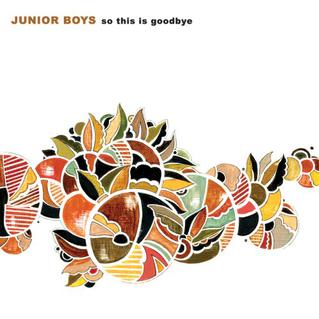
Before 2011’s It’s All True, Junior Boys recorded “Double Shadow” on So This Is Goodbye. Five years and a Kode 9 remix later, the song is still memorable for its meter—Bacchic monometer—and the two ways the meter marries the song.

The history of the meter marries the song. The song uses an unusual foot called a Bacchus: ~ — —. One unstressed syllable followed by two stressed syllables. Ancient Greeks used it in hymns to its namesake. “Double Shadow” is a hymn to a lover.

The structure of the meter also marries the song. The unstressed syllable is a person and the two stressed syllables are two shadows. At the same time, the duplicity is undercut by singularity: at only one foot per line, the meter is called monometer. The meter contradicts the lyrics: the breakup is coded into the meter.

The last person to use Bacchic monometer in English was the poet Gwendolyn Brooks in “We Real Cool,” over fifty years ago. Today, “Double Shadow” not only describes a lover: it is memorable enough to recall a lover, even fifty years later, and all for the meter. Brooks is dead. For poets today, the arms of the living (and the lip of the dying) are in others’ hands.


{ 0 comments }

Vincent Moon, `the Happiest Man on Earth`

by HRM on November 28, 2011

by Franziska Knupper

Vincent Moon

Independent filmmaker Vincent Moon only needs a sleeping bag and his camera to do what he does. Right now he is in Indonesia, capturing the city’s music scene on tape.

“I never understood why anyone would study film,” says Vincent Moon (real name Mathieu Saura), sitting in a little café in Paris on the Rue Rambuteau. “Personally I think that studying art, philosophy or any other science provides you with more of a profound background that you can then use for all your further work.” He takes a sip of his Espresso., “All the filming is just learning by doing.” He contemplates for a moment: “Yes, you just have to go for it, get started.”

Vincent Moon was lucky. He met the right people at the right time. There was Chryde, the founder of the music association “La Blogothèque” with whom Moon created a completely new approach towards music: “I absolutely hate music videos”, Moon says, explaining his motivation.

The result was a large amount of Dogma95-like clips of musicians such as Bon Iver, Efterklang, Beirut, Noah and the Whale, Sigur Rós, Andrew Bird, Vic Chesnutt David Bazan or Okkervil River. Clips that resemble guerilla film making, clips that are simple and pure. Long one-take-recordings full of details. There is a glimpse of hand or a guitar, a close up of curly hair, the silent sound of someone playing the accordion in the background. Recorded on streets, in old fashioned elevators, in parks with playing children or on hidden alleyways the settings are often absurd but always incredibly creative. The members of the band Beirut are waving out of windows, Phoneix are having a jam session in front of the Eiffel tower and Mogwai are sharing their stage during a concert. Moon is very close, standing right beside them, moving silently among them, almost invisible. He is a discrete director just capturing a moment: facial expressions, warm colors, voices, hidden moments.

Vincent Moon

Photo by Francois Roy for La Presse

A combination of courage, free spirit and self-confidence have brought Vincent Moon this far. His life has been on the road for the last two years, the only constant feature in his life the music and his camera.

Never resting, never absorbing… “Sometimes it is exhausting to be travelling all the time, yes. But I believe a lot in the memory of the body. So even if my mind does not have time to take in all the impression, my body keeps them for me.” The influence of spiritual values has clearly influenced his work as well: “I lose interest in English music, in people singing in English. The Western world does not attract me as much as it used to do,”he says playing with a Brojanica, a Muslim prayer bead. “This calms my nerves.”

His new project takes place in Indonesia where he is trying to discover the city through its music. A few impressions of a place, a documentary about its sound: “It’s going to be called Jakarta, Jakarta! Isn’t that such a nice title? ”

One of the fundamental principles is that he never tries to make money out of it. “I pretty much live from what I earn by projections from time to time. I am always staying with people I meet through my work or during my travels who invite me for a drink or a conversation,” he laughs, then shrugs his shoulders: “I am the happiest man on earth.”

www.vincentmoon.com

{ 0 comments }

Erring on the side of Beauty

by HRM on November 24, 2011

David Lynch and Mathematics at the Fondation Cartier by Hattie Middleditch
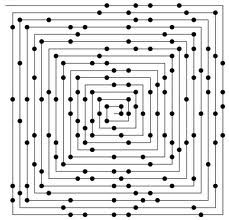
Ulam’s spiral, presented in The Room of the Four Mysteries in the central demi-sphere as part of a film by Beatriz Milhazes.

Ulam’s spiral, presented in The Room of the Four Mysteries in the central demi-sphere as part of a film by Beatriz Milhazes.

Mathematics: A Beautiful Elsewhere brings together the work of mathematicians, scientists and artists to transform abstract theories of mathematics into a nearly-hallucinatory experience. This latest exhibit at the Fondation Cartier pour l’art contemporain, Paris, is designed to offer its visitors a ‘sudden change of scenery’. Though the ideas generated by certain pieces in this exhibition are somewhat inaccessible, this remains a fascinating exploration of the mystery and the beauty of mathematics.

Mystery is perpetuated not only within the pieces and puzzles themselves, many of which are initially impenetrable to the mathematically untrained. It also lies more fundamentally within the very essence of the subject under examination. The message runs clear throughout: mathematics is in itself a mystery, the truth of which may never be attained.

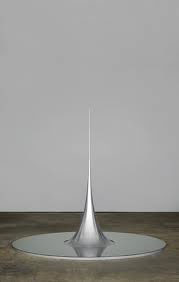
Hiroshi Sugimoto, ‘Surface of Revolution with constant negative curvature’, 2008.

Hiroshi Sugimoto, ‘Surface of Revolution with constant negative curvature’, 2008.

The exhibition starts with the Library of Mysteries, housed in a zero-shaped structure. The focus of this space is an audiovisual installation put together by David Lynch which presents a collection of books selected by Misha Gromov for their importance in the history of mathematics and of human thought in general. Quotations from the titles are also projected onto a screen, each a musing on how the human mind encounters, and rationalizes their surroundings.

The library ranges from Heraclite’s Fragments, written around the 6th century B.C., to Alexandre Grothendieck’s Récoltes et Semailles. A quotation from the latter work talks of the ‘going back and forth between the apprehension of things and the expression of what is apprehended’. This goes to the heart of what many contributors to this exhibition seem to believe mathematics is about. It is a way of apprehending our exterior world and simultaneously a means of expressing, via mathematical structures, that which we have apprehended.

David Lynch, Universe coming from Zero - Animated film projected onto the ceiling of the Library of Mysteries

David Lynch, ‘Universe coming from Zero’. Animated film projected onto the ceiling of the Library of Mysteries.

The Joy of Math, a film by Raymond Depardon and Claudine Nougaret also deals with this idea. Mathematicians involved in the creation of the exhibition are able to express themselves in their own words. Sir Michael Atiyah talks of how our exterior visions and pictures reflect the exterior world yet are entirely different. In mathematics, where ideas are most fluid, this means the interpretation of the outside world through the internal visions and structures which the mathematician has created or gained from experience. What makes maths special in the creation of these visions, according to Alain Connes, is that ideas can be transplanted between different fields. This is because mathematical structures exist in a number of parallel universes. Mathematics questions materialism as a naïve theory in that it reduces reality to material things. Reality in fact is so much more complex than this and it is through mathematics that we are able to conceive of it. The result is beyond exciting. Just like in Alice in Wonderland, Connes enthuses, you are lead to discoveries that you could never possibly have imagined.

Yet, as Atiyah emphasises, the mystery is far from solved. If the goals in human life are the search for truth or beauty then Atiyah recommends erring on the side of beauty. To him, beauty is a subjective quality. That which we personally see and understand to be beautiful is certain. Truth on the other hand is an unattainable goal: ‘we will disappear long before we reach the end of the road to mathematical truth’. The idea of mathematics as an infinite journey of discovery is examined also in the Room of the Four Mysteries in which text by Misha Gormov is interpreted by Patti Smith as an accompaniment to a number of visual installations.

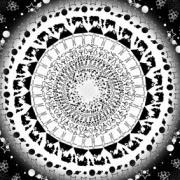
Penrose Tilings

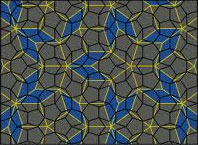
Penrose Tilings, presented in a film by Beatriz Milhazes projected in the central demi-sphere of The Room of the Four Mysteries. A giant collective of penrose tiling is also displayed on the wall of the space so that visitors can arrange two types of magnetic tiles.

The four mysteries of the world are outlined as: physical laws, life, the brain (‘an accidentally developed mass of organic matter’) and mathematical structure. Although everything we see has evolved under the influence of physical laws, these have not helped us to elucidate the structures of life. Mathematical models are the only way to represent any of these structures in a format which is comprehensible to the brain.

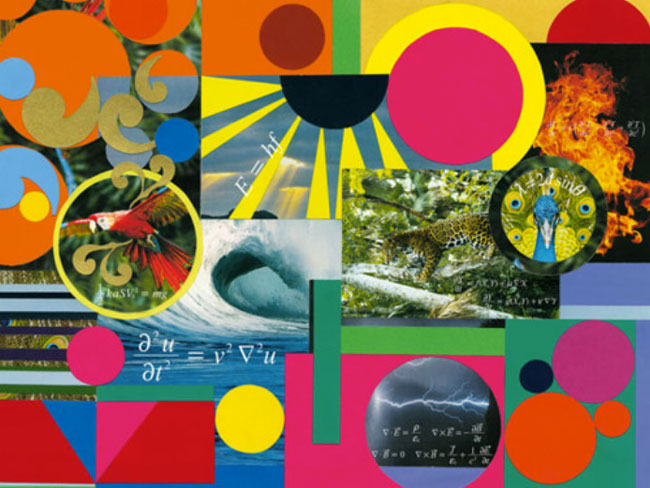
This idea is reinforced by Beatriz Milhazes’s collages displayed on the walls and in a central demi-sphere in the same room. The collages are a composition of landscapes and animals to which sets of equations have been added illustrating how natural phenomena can be displayed using mathematics. However, as Smith’s dialogue reminds us, mathematical structure is in itself a mystery: the puzzle of human life remains unsolved. The fact that Milhazes’s collage is entitled Paradise emphasises the fact that this is a perfection that has not – indeed, may never – be attained.

Paradise

Penrose Tilings, presented in a film by Beatriz Milhazes projected in the central demi-sphere of The Room of the Four Mysteries. A giant collective of penrose tiling is also displayed on the wall of the space so that visitors can arrange two types of magnetic tiles.

{ 0 comments }

ISSN: 2116 34X