Boys Don’t Cry

by HRM on October 19, 2012

Reviewed by: Elysha Chang

Boy's Don't Cry

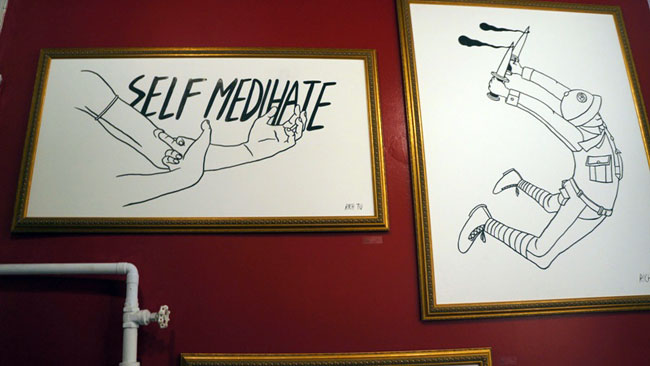
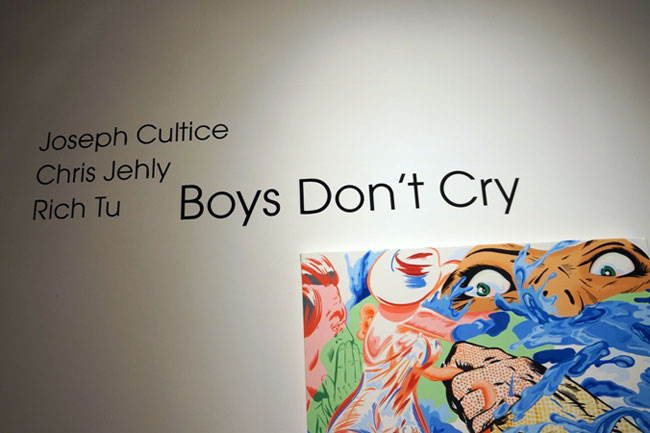
On October 4, 2012, I trekked to Manhattan’s far West Side for the opening reception of Boys Don’t Cry, a debut of Baang and Burne’s three newest additions. Boys Don’t Cry features Joseph Cultice, Chris Jehly and Rich Tu, three visual artists working with different mediums and very different aesthetics. A sort-of interconnected triptych, the collection is meant to give us a glimpse into the emotional/intellectual expanse of a boy’s (man’s?) life.

Boys Don’t Cry investigates male desire in all its forms. What is want? What happens when it is fulfilled? Not fulfilled? What comes from too much desire, too little? What is impulse versus hunger versus longing? Through paint, drawing and photography, Cultice, Jehly and Tu broach questions, fears and hopes that, according to the show’s intent, reveal the richness of the male mind.

Boy's Don't Cry

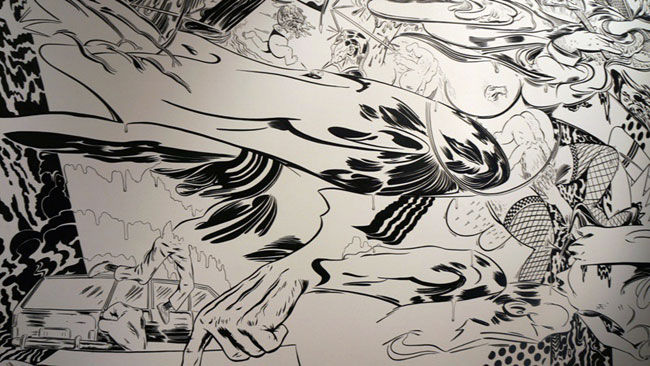
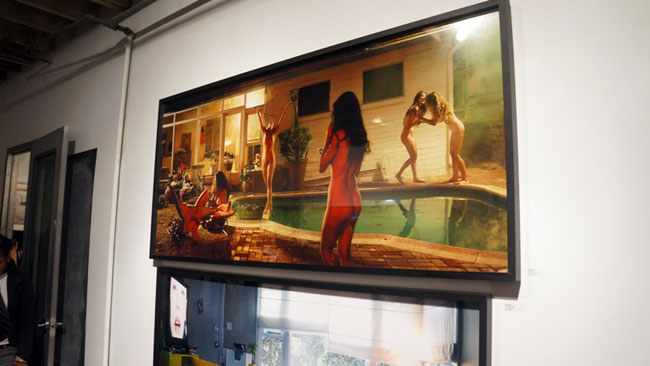
Cultice’s photographs linger in a way that the others do not. There is something deeply nostalgic and melancholy, that his pieces seem to feed off of. Jehly’s pieces were striking for their chaotic nature, demanded our attention for as long as we could bear to look. Meanwhile, Rich Tu’s pieces were cordoned in a red-walled room on their own. I’d seen them before, several months ago at his own show, There Will Be No Survivors. Seeing them now in the context of these other pieces made it a different experience.  This new environment brought his wit and conceptualism to the forefront. Alongside Cultice’s lush photos and Jehly’s chaotic, absurdist drawings, the simplicity and control of Tu’s pieces refreshed a gallery that was swimming with color, people, paint, wine, and sweat.

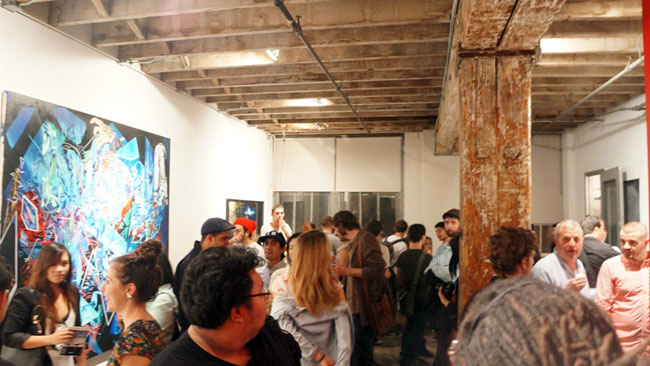
That is to say, it was really crowded and hot in there. Amidst the other white-walled, enhanced-echo galleries in 548 W 28th, Baang and Burne’s space stood out that night for its exposed piping, unfinished ceilings and poor air ventilation. It was teeming with young artists and art connoisseurs whose faces were beaded with sweat and whose hair might best be described as anti-coifed.

Boy's Don't Cry

Which is, partly, what Baang and Burne is going for. A self-proclaimed “unconventional art gallery with the spirit of an indie rock band,” Baang and Burne is meant to be a refuge from the highly commoditized world of contemporary art. According to its mission, the gallery’s goal is to showcase art that is culturally subversive, that is challenging, that engages people and connects them with one another. One of Baang and Burne’s main differentiators is that it prioritizes showing art over selling it.

Boy's Don't Cry

A friend and I were introduced to the gallery’s Co-Founder and Executive Director, Charlie Grosso. She had high, bright cheekbones and a suppressed smile. She was dressed in a simple black shift, sipped red wine from the nice kind of plastic cup. We asked the typical questions (What is your favorite piece in the show? Has anything sold yet?  How do you select the artists you represent?). She answered dutifully, and then turned her attention to what interested her, offered some details about a publication’s recent criticism of her swift accrual of three young, male artists to the gallery’s roster.

Boy's Don't Cry

“We were critiqued for being female minority directors and bringing on three male artists in the last six months.” She rolled her eyes, confident and nonchalant. “To me, it’s about the art, and what we like in the art. If they’re men or women, so what? None of that matters. It’s about the work and if the work suits the mission of the gallery.”

While the show’s title is gendered, the art itself is not. Boys Don’t Cry is an expression of human desire in all of its crudeness, its inanity, its beauty, its confusion, its art.

Boys Don’t Cry is up until November 8, 2012.

{ 0 comments }

SWEETEST TABOO

by HRM on October 19, 2012

Rosa Rankin-Gee on the honey from the Be:e

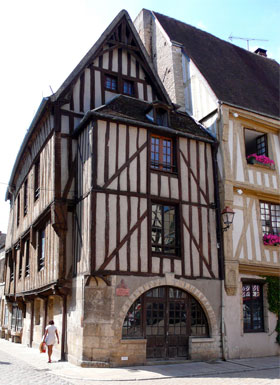
Serein – serene – is a great name for river. It runs leisurely through deep Burgundy, and Noyers, one of the medieval villages along its banks, is regularly voted one of the most beautiful spots in France: all limestone, lime trees and freshly-painted volets.  This is where you’ll find La Porte Peinte, an international arts centre, unassumingly poised between a Crédit Agricole bank and a charcuterie shop.

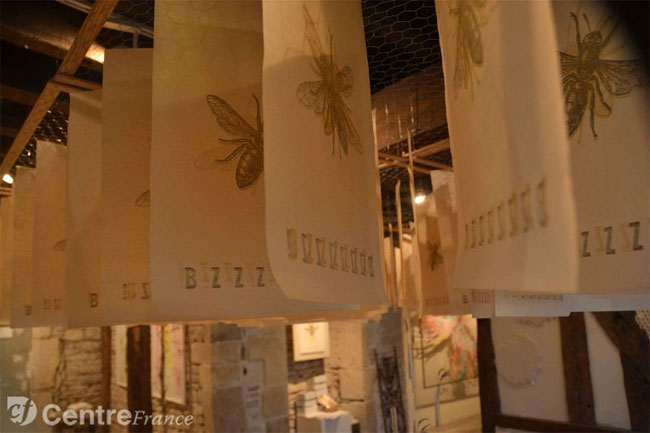
La-Porte-PeinteLast year, the centre launched its striking 160m2 ground-floor gallery space with a cocktail no-one had heard of before : ‘CaliforNoyer’, where 10 West Coast artists came to be shaken up with the small, cobbled cité. This year, the centre’s second major show follows a theme with a slightly more conventional artistic tradition: ‘Be:e’. (Ignore the colon; the artists did.) The Bee, and all things associated: honey, beeswax, buzz, sting.

The first surprise is how many contributors there are. The gallery has four rooms, the price list is four pages – everything is full. The second is that the pieces are bulls-eye on theme. Considering the relative isolation of the gallery and its newcomer status on the global arts scene, the wealth of international artists – and their willingness to produce fresh, focused material for the show – is testament to founder Michelle Anderson Binczak’s compelling curatorial skills.

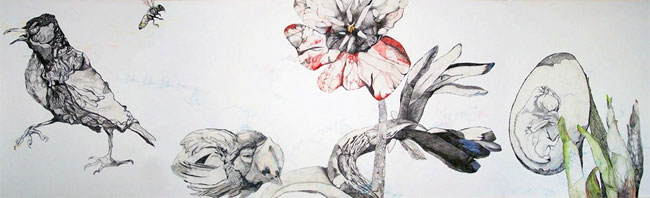
Naturally, the quality is not all Manuka. Stars of the show, however, include young Dutch artist Bette Adriaanse, whose epic Lente (unfortunately obscured during the vernissage behind the moonshine punch and terracotta stacks of pain d’épice) shows just how much you can do with a pencil. Fine, metallic, open-beaked birds; the cross-section of an avian foetus; the similar fragility of a bee’s wing and a poppy petal – all of it rendered with grace and precision.

Drawing-Lente

Michael McConnell’s triptych of honey-dipped bears is as fun to look at as it is to say, and Marta Solomianko’s beeswax creations are cumulatively impressive. Another great feature of the show is the multi-form response to the theme. As well as the sculptures and murals, a hive of live bees welcomes you and literary fiction awaits in the final room. A short story by current writer-in-residence Nathaniel Krause is Carver-esque and presented intriguingly in a self-carpentered wooden box. A bizarre Oulipien piece using and re-using over 100 apiculture terms, and the prologue of The Honey Farm (by HRM’s very own Harriet Alida Lye and of which you can read a section here – The Honey Farm), are two further highlights.

One piece that may be less universally pleasing is Blood and Honey by Helsinki-born Riiko Sakkinen: a duo of ketchup and mustard bottles, the type you get in a cheap diner, re-labelled as the words of the title. It’s playful, if a little trivial, and while it may deserve its place in the show, its unfathomable price-tag in direct conjunction with the description of media (“permanent market on condiment containers.”) makes it the type of piece that puts the bees in the bonnet of the bitter “Is this art???” brigade.

Overall though, the show is a deserved success – rounded, rich, and pleasing to plural senses. There is something honey-ish in the air, and when the live bees have a quiet day, visitors can pick up one of the ‘bee mandolins’ created by the Festival O-Bon des Abeilles, a simple four-string cardboard construction which when strummed creates the hum of a whole hive.

bees

Be:e runs until 28 June 2013.  Noyers sur Surein is 1h20 mins away from Paris. For further details, please see www.laportepeinte.com

{ 0 comments }

Nuit Blanche, Despite the Grey

by HRM on October 17, 2012

Two art-hunters take Paris

Nuit-blanche

1. Patrick Errington explores the left bank

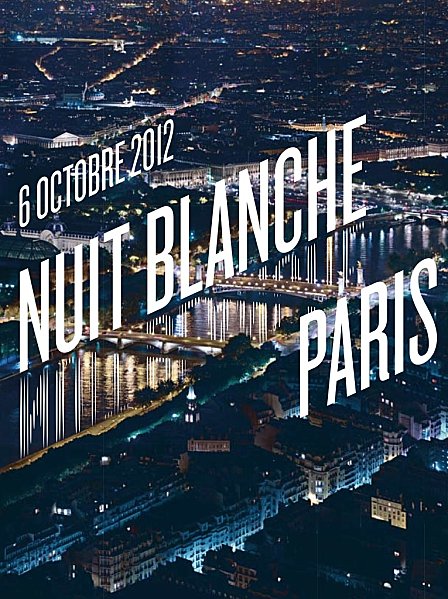
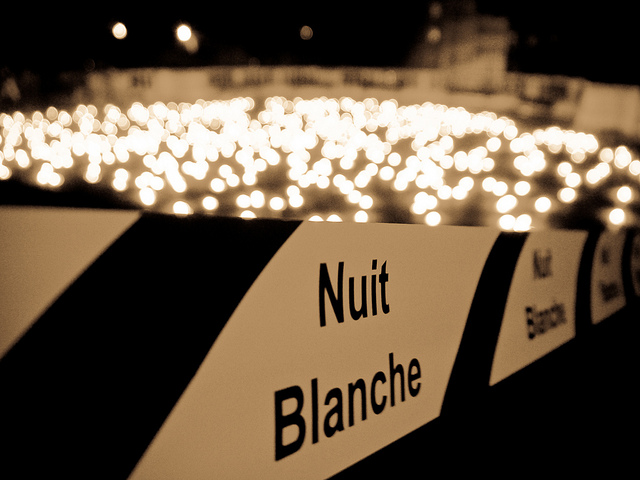
This was my first time in Paris for the much-hyped Nuit Blanche festival and my goal was to stay general and experience as much as I could. I’ll admit to rather sodden spirits as the rain from the morning clung to the city through the afternoon and into the evening, but once united with my small crew of cohorts, we resolved to take to heart the message glowing above the Samaritan building: “du soleil dans la nuit.”

We arrived at the Bibliothèque nationale de France (BnF), the first and only preplanned destination, to find a surprising number also bringing a little sun into the night. Already, a queue stretched from the doors of one of the towers, umbrellas looking like a huddle of mismatched mushrooms. As we waited (not long—the queue did move surprisingly quickly) to take the lift to the specially opened eighteenth floor of the BnF tower, we caught the first glimpses of what Paris had in store: the red glow of a light installation under the passerelle Simone de Beauvoir and, on the boardwalk, part of Julie Desprairies’ line of dancers along the edge of the stairs performing her Tai-chi-esque choreography dressed head-to-toe in bright spandex.

The top of the tower itself did provide a not-often-seen view of the city, but with the shrouding grey drizzle it did not unfurl the spectacularly lit cityscape we had hoped. The multicoloured smoke from the factory in Ivry on the outskirts of town did stand out against the grey, however, because of the rather strange choice to use north and easternmost tower of the four at the BnF, the greater highlights and eye-catching monuments were blocked by the others towers even if not by the rain. Even the mayor of Paris, Bertrand Delanoë, seemed underwhelmed when we snagged a glimpse of him as we suddenly found ourselves caught up in his entourage of photographers and guards.

After making our escape back to ground level and spying a brazen Parisian try to join the dancers along the boardwalk, we moved down along the river toward the centre of town. On a whim, we stopped in at the Université de Pierre et Marie Curie, intrigued by the wash of neon lights and strange sounds sluicing out the door. Inside, we found one of the more intriguing installations of the evening: a soundscape presentation designed by Michel Risse and the company Décor Sonore. Using the architecture of the courtyard and the enclosing, modern buildings, performers and recordings of various mechanical white noises presented a veritable garden of sound and light in an attempt to display the semi-mythical ‘Effet Sharawadji.’ While I still have no idea what this effect was meant to be, nor the meaning (if there is one) of the stormtrooper style costumes of the performers, the effects of the sound reverberating through the smoky, neon and metal space was fascinating. At the end, we had the option of taking in another view of the city from the university tower, but as the rain continued, we decided to forego the queue in favour of continuing our ambling along the river.

Another installation we were all keen to see was the much anticipated foam sculpture, the ‘bouquet final’ of Michel Blazy. On the way, though, we were arrested by the sight of fire exploding along the river. Designed and created by the much-lauded Groupe F—the pyrotechnic team made famous by their special effects for events like the Olympic Games in Athens and Turin, and the year 2000 New Years celebrations in Paris—their skeletal boat lit up the river in gouts of fire. It made quite a show, spinning slowly between the bridges spewing flames to the awe of the gathered crowds before racing along down the Seine.

We did eventually get to Blazy’s foam sculpture, housed in the classical walls of the City Hall of the fourth arrondissement. Like the fire boat or the ‘Effet Sharawadji,’ I’m not quite sure how to define it as ‘art,’ but Blazy, who is known especially for his installations constructed of household materials, did manage to create a stunning structure out of a simple scaffold and what seemed to be the entire city’s supply of dish soap. Looking from a distance like ice or snow, the foam pouring from the scaffold was awe-inspiring. However, I was equally fascinated by the murals and the stunning classical architecture of the building, and the juxtaposition with the soapy mass in the centre was, to me, slightly off-putting.

It was just after that, when we stepped outside again, the time nearly 3 a.m., that the enormity of the event struck me. Here we were, in the middle of a city whose artistic history so often overwhelms its current endeavours, and yet even in the rain and in the wee hours of the morning the streets are flooded with people celebrating art in all its forms. I’m not saying it all appealed to me personally—I still don’t know if you can call a foamy scaffold ‘art’ any more than I can the soap suds as I wash dishes—but that’s just the nature of art, and people are out supporting it, creating, exploring. And that’s the sun I saw shining through the night.

nuits-blanche

2. Stephanie Papa finds Philip Glass

You have to find an engine for change. And that’s what collaborative work does. Whatever we do together will make us different.
– Philip Glass, New York Times Interview, October 5, 2012

Another piece of sheet music lilted to the floor, on top of the others piling up beside the piano. It was almost 2am and I was staring at the ceiling of Collège des Bernadins; the strangers and I were laid out on our backs as stargazing if in a field. Some had been there for the entire five hours, but I, a little less faithful, had showed up late. After two consecutive years of mediocre Nuit Blanche experiences (either the allure of an artistic all-nighter didn’t deliver, or it was simply my bad luck), I had been in no hurry to queue up in the rain and leave ambling around town up to chance. This year, however, the 11th edition of Nuit Blanche seemed more promising. Mysterious happenings on the menu included paper falcon making, a pirogue boat installation from St. Denis to Canal Ourcq and much more.  Something on the program especially caught my eye: a Philip Glass marathon concert, “Alterminimalismes 12.”

I was coming from the usual Nuit Blanche installments that night which seem to get lost in translation—a neon dragon made of mesh, a courtyard where one very wet woman walked through a sheet with cloud silhouettes projected on it. The expos in certain church also seemed to be hit-or-miss. L’église Notre-Dame-des-Blancs-Manteaux had an impressive group of choirs performing consecutively, including a children’s choir singing Fauré arrangements that left most of the Nuit Blanchers breathless. However, the other, more famous Notre Dame’s late-night installation missed the opportunity to risk the avant-garde, projecting a film explaining the church’s history.  (Yawn). Yet when I managed to cross the Seine and reached Collège des Bernadins, “Glasstroduction” was well on its way, and the audience well sedated. The crowd was free to come and go, parents carried out passed-out children draped over the shoulders, couples tried to find their places among the lounging listeners.

Philip Glass, the composer, is no stranger to Paris, having moved to the city in 1964 for a short period to study with renowned composer Nadia Boulanger and where he eventually met sitarist, Ravi Shankar. The hall of the Collège was a stunning setting for Glass’s compositions as well, the acoustics being a key element for his tones to orbit and swell.

Only pausing once or twice to take a sip of water in between movements, the pianist Nicolas Horvath went through pages of scores. The final cycle, most of which was played with only his right hand, seemed almost effortless. The performance in its entirety, from “Glassworks,” to his work for film, up to his piece “600 lines,” also illuminated Glass’s interest in Buddhism; the consistent repetition of blurred musical sequences was almost like hours of meditation, leaving most people transfixed. Horvath couldn’t help but continue even after the last note, playing the exit music as we filed out of the hall into the night. The last survivors crouched on the ground, sifting through the sheet music to answer the question that had been engrossing them: what was actually written on the page?


{ 0 comments }

In the beginning

by HRM on October 16, 2012

African Travelogue, part 1

Rousseau, The Dream

Our contributing editor, Lacey Haynes, recently traveled through Africa. We will be releasing weekly installments from her travel log.

Chobe National Park – Botswana
Tuesday, early evening

Sitting at the edge of the boardwalk built this year at the Chobe Game Lodge, I can see at least twenty-four elephants. Elephants! Three or more are babies. There are thirty or more skirting the periphery but they fade in and out of view. Someone said to me that elephants look like they’re wearing baggy jeans. It’s a very good descriptor. There are hippos and birds – so many birds, calling and soaring overhead, standing on the river’s crest. In the water to my left, a splash. Everyone hopes it’s a tiger fish. With a glance, I cross the river into Namibia where there are a dozen or more large dark animals floating on the heat waves. Elephants have learned to come back to Botswana at sunset. Their predators, the Namibian poachers, come out at night.

{ 0 comments }

In Discussion at Shakespeare & Company
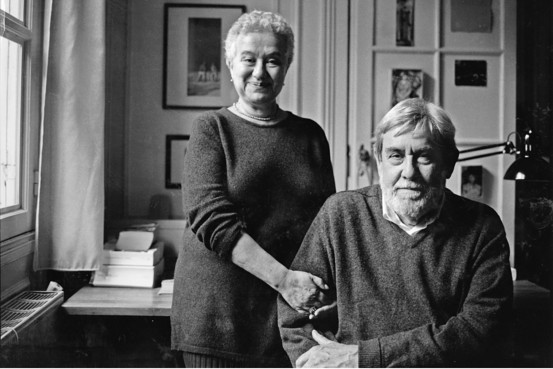
Richard Pevear and Larissa Volokhonsky

Richard Pevear and Larissa Volokhonsky are the translating dream team. Husband and wife, American and Russian, tall and short – together, they have translated twenty-one classic Russian texts into English, working their way from Anton to Zhivago.

We joined them on Monday, October 1st at Shakespeare & Company bookshop. There, with the proceedings smoothed along by Professor Dan Gunn of the American University of Paris, Pevear and Volokhonsky gave performative readings of several of their translations and answered questions on the nature and art of literary translation.

Discussed: inventing proverbs, a Russian Winnie the Pooh, Beckett’s self-translations, and whether the translation can ever be better than the original.

war-and-peaceQ: I was wondering—obviously a lot of the books you translate date from decades or centuries ago, and I imagine that, much like the English language, the Russian language has evolved in that time—and I was just wondering how you deal with, for example, an expression that might have been very current at the time of Dostoyevsky but which has fallen out of use now. Would you look for an equivalent English expression from the time or would you try to find something which fit more with current language?

RP: I would try to find something that would work in current language but maybe had something of an old fashioned sound, if it should do. But certainly I wouldn’t use something which had fallen out of use or become markedly antiquated. I would never try to use antiquated language. I think that that’s a wrong—I mean, part of translation is in time, as you said. And in a way, the translation should be brought forward. On the other hand, we try not to use words that didn’t exist in the time of the original. I use this Oxford dictionary that gives you this historical date of when a word entered the language. And almost always I try to follow that. I sometimes break my own rule, but if it’s a saying or something like that I would try to find, first of all, an effective saying—I sometimes invent them. I’ve invented several proverbs in English. (He laughs.) There’s one in Gogol: “Neither Jack of the hill nor Tom of the mill.”

LV: (she recites it in Russian) It’s a good one. But even in this text that we last read, she uses rhymed—

RP: —And so does he—

LV: —rhymed sentences, and we try to do that. But we never do what’s called ‘a version for a modern reader.’ We don’t do that.

Q: Thank you. Now, I don’t know if you translate poetry, but translating poetry it must be almost impossible to achieve rhyme—words that rhyme at the end of each line.

RP: Yes, we did translate the poems of Zhivago at the end of Dr. Zhivago, which rhyme consistently. I didn’t rhyme them. Russians believe that any translation of rhyming verse has to, first of all, rhyme. Russian is very rich in rhymes while English is rather rhyme-poor. And so you get forced into saying things the poet never would have said just to achieve a rhyme. Which, I think, is the height of foolishness. Besides, we have a long tradition in English of unrhymed verse. For 150 years or so. Rhythm is important, though — [Boris] Pasternak has one poem in the form of a tchastouchka (an absurd dance form with rollicking rhyming verse) and he keeps the whole thing going in this rhythmic way. I tried to capture that rhythm without the rhymes. It’s a complicated question. Yves Bonnefoy has written very well about that. When they produced the entire Pushkin all in rhymes—dreadful!—but it all was in rhyme, in French. This was done also in America, under the influence of Brodsky, who also believed that every translation had to rhyme if the poem rhymed. They produced a whole collection of the Golden Age of Russian poetry, all of it trash. But it did rhyme! But it so distorts the poetry. Poetry doesn’t depend on rhyme—it depends on much broader rhythmic and compositional things.

LV: A Russian would disagree with you.

RP: (He laughs) But you are not ‘a Russian.’

LV: But Russian poetry is on a different stage, so to speak. Not in terms of progressiveness, but it’s simply at a different stage of its life.

RP: Larissa’s going to prove me wrong by pointing out that my translation of Pushkin rhymed. No, but it’s a children’s poem—children’s verse that doesn’t rhyme is just ridiculous.

Richard Pevear and Larissa Volokhonsky

Q: I read certain books in two and, recently, in three languages and sometimes I find myself thinking that the translation is better than the original. Do you think it’s possible? And if it’s possible do you think the translator took some artistic liberties [with the source text]?

RP: In principle, I think that the idea that the translation is better than the original is nonsensical. Because the original is the original. And the translation wouldn’t exist if it weren’t for the original, so the original has a prior claim. But then there’re all kinds of freedoms. Every time you say something about translation, it turns out the opposite is also true. You know, I loved, when I was a young student, The Golden Ass translated by Robert Graves. Now Robert Graves translates it into very simple narrative English. But it turns out Apuleius wrote extremely ornate, difficult Latin prose. If [Graves] tried to translate that into English, nobody would read it. But he made a wonderfully readable, hilarious book, out of The Golden Ass, which has something essential of The Golden Ass, but it’s completely different, stylistically. I’ve heard people say that Scott Moncrieff’s translation of Proust was better than the original. I have heard people say that. But they no longer say that, now that there are three more translations.

LV: There was a translation of Winnie the Pooh into Russian, which we all read when we were little. And it was an excellent and very inventive, brilliant translation. And some people—in fact Boris Zhakhoder [the translator] himself—said that it’s even better than the original.

RP: He made the mistake of saying that at my dinner table! With a whole group of Russians. And he said, “Some say it’s even better than the original,” and then he looked at me! (He laughs)

LV: It’s a good translation. But it’s very different from the original. Milne is never sentimental, for instance, and Zhakhoder is. He added a little bit of syrup. It was inventive. I mean it was a wonderful book and well-loved, but I cannot say it was a case of improving upon the original. It’s just something else.

Dan Gunn: Perhaps I could just add one word, being a person who works on Beckett: That might be a particular case, him being someone who translated his own work, changed it enormously sometimes. Cut a third of his novels out, even. And, in his case, I do think there’s translations, which I think—or which I, at least, prefer to the originals. That, in some cases, add to the original. If I just give one example, from Premier Amour, by Beckett. Just an example of how he can change it, with artistic liberty, as you said, if you’re the author himself. He says, “Personnellement je n’ai rien contre les cimetières.” So you imagine a straight translation to be, “Personally, I have nothing against cemeteries.” But the translation twenty-five years later by Beckett is, “Personally, I have no bone to pick with cemeteries.” I think one could say that that’s sort of an improvement, or at least there’s a better yield.

RP: Beckett could do it.

doctor-zhivagoQ: I’m curious about the nature of your collaboration. How do you iron out differences and how you end up coming to a final decision when you maybe disagree—if you disagree?

LV: We always agree!

RP: After a while. (pause) But that’s not an answer. That’s an avoidance!

LV: No we discuss things. Endlessly. And, for instance, I write the first draft, and I give it to Richard and he works with it and then he gives me the result. And I look at it against the original and I say, “Why on earth did you say that!”

RP: “You must have looked in the dictionary!” That’s what she says.

LV: And then we discuss it, and I say, “No, you can’t say that, that’s not it.” It’s an endless process of going back and forth until we reach a version that we both are pleased with. (To Peaver) Is this right?

RP: Yeah, that’s right.

shakespeare-coQ7: Have you ever come across particular passages that talk about things that are unique to the Russian consciousness that maybe we don’t understand as much, or just cultural differences that have presented difficulties for you?

RP: We may be running into that now with the Gogol play we’re currently translating, because it’s extremely Russian in mentality. It’s hilariously Russian but I don’t know if an American—but then the French translation is very good. Everybody laughed, anyway. This play was so extraordinary that when it was first produced the Emperor came, Nicholas I came, and was laughing his head off. And at the end of it he said, “We’re all in it! We’re all in it! Me, first of all!” So there was this immediate identification of the audience with this play. And they even said that the characters and the audience were on both sides of the lights. They were laughing at each other. So I don’t know if we’ll be able to catch that in English.

LV: In Liskov, there are some places which are very hard to deal with, because they do speak to us [the Russian people]. We do use footnotes in our translations.

RP: There’re whole kinds of experiences that are very deeply Russian that we don’t have, we never had. So it’s very hard to read yourself into it.
Q: Going back to the question of—well with English, it’s a complex language  where it has some lexical characteristics from the Romance languages and lexical characteristics from the Germanic languages, and I wonder if that plays a role in your translations? If you find yourself using a lot of Germanic equivalents versus Romance equivalents? Does that change? Do you find yourself doing more Romance derived words with Tolstoy, for example, who’s somewhat more French inflected than, for example, with Gogol? Do you feel a difference and does that play out in your translations?
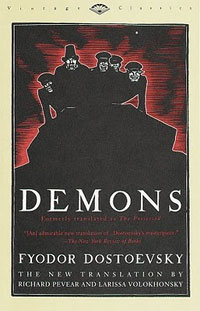
demonsLV: I don’t think we can establish any distinctions from writer to writer, it’s rather we have to consider each particular case. Because in Russian there are also words with Latin roots then there are simple Russian words so then we decide depending on that. If Dostoyevski’s hero uses some complicated, sophisticated word, we might use words with a Latin root.

RP: I do think about it. The texture and the sounds of the words. How they feel. How Latinate they should be.

DG: I spoke a lot with a man who’s translating The Letters of Samuel Beckett, Volume I into French and he was amazed how Beckett almost always goes for the Latinate word, rather than something with a strongly Saxon feel to it. So I think it is possible with writers with an English push one way or another.

RP: And Tolstoy, you’re right, very often uses French syntax in Russian. And I think it’s important to try to keep that.

LV: Dostoyevski also, very often uses Gallicisms. We also try to keep it whenever possible, just to give it a little different rhythm.

Pevear, an American translator and writer, and the Russian-born Volokhonsky, met in 1976. Their collaborative translations have won the Efim Etkind Translation Prize, twice won the PEN/Book-of-the-Month Club Translation Prize, and been noted worldwide. While largely translating from Russian to English, they have produced translations from Greek, Italian, and French.

Daniel Gunn, most known for his work on the Letters of Samuel Beckett, is a Professor of Comparative Literature, English, and European and Mediterranean Cultures at the American University of Paris as well as the Director of the Center for Writers and Translators.
{ 0 comments }

ISSN: 2116 34X