In Conversation at Shakespeare & Co

Cafés are entwined with the very idea of Paris, inseparable as baguettes and artists and berets.
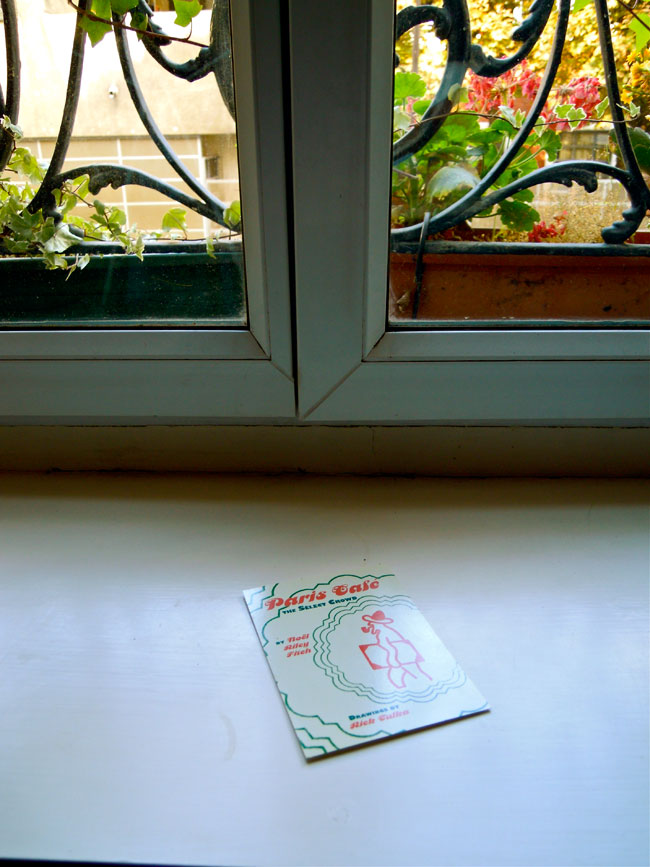
At Shakespeare & Company, noted author and savant of just-about-everything Parisian, John Baxter sat down, caffeine-free, with two experts on cafés and, in particular, the famous Le Sélect. Writer Noël Riley Fitch and illustrator Rick Tulka teamed up to produce the book, Paris Café: The Sélect Crowd (Soft Skull Press). On the térrasse in front of the bookstore, they shared their thoughts and a few anecdotes on the subject of the Paris café.
DISCUSSED: Renting sidewalks, coffee during the Occupation, how musicians found each other before the age of text messages.
The Great Third Place
JB: As a start, I’d like to read a quote from Herb Lotman’s book about the Left Bank, because it seems to me that it touches on a point about cafés which perhaps not everyone has thought about. Herb wrote, of cafés, “One could not only meet friends in a café, but conduct business there, spend half a day writing letters, or even a book. One needed no invitation to strike up a conversation with a stranger at a neighbouring table. An appointment at a café often replaced an invitation home. It kept home inviolate. And if home was a garret, all the more reason.” (To Fitch) Do you find that cafés are most important for their social significance or just to hang out, just for the fun of it?
NRF: Well I think cafés are important for all those reasons you’ve just mentioned. They are really the great third place in our lives. We have our home, we have our workplace, and then we have the café. Or, in some people’s case maybe the nail salon or wherever you go to talk to people, to meet people who share your interests, to exchange gossip. The cafés are where newspapers began, where first thoughts of gossip began. They’re connected with history, with literature, with music. They’re the centre of social life. They sort of took the place of the church and the town square as a meeting place, for exchange. Impressionism started there—all the “isms” seemed to start there. I think the French Revolution started there. It is the great third place. And you can see specifically in the Paris café—the first one started in 1686—something like that.
JB: Rick, you’re an artist, you work in a café. Why? Is it particularly inspirational? Or do you get free coffee?
RT: Oh, no I don’t get coffee! No. Since I’m an illustrator, I work at home, alone all the time, so it’s really just a place to get out of the house. And I find so often that I love it, drawing the people there, just passing the time. So I use it as a place to work—I don’t socialize in there, I just go there to work.
JB: I remember Hart Crane got into a fight with a waiter at Le Sélect over the bill, and ended up in jail! I don’t know if you’ve had such a rich experience yourself—
RT: Oh I’ve seen people being thrown out of there. But I go there for the people, for the faces. And the way it’s set up works well for my drawing. I’m able to draw people without them knowing. And I never show people the drawings, the caricatures. I just keep to myself, you know?
JB: So you don’t sell the drawings?
RT: Oh, yes! You can buy them. They’re all for sale!
JB: You know, I never realized until recently that it’s called the Sélect because the family is called Sélect. Isn’t that right? (Tulka shakes his head) That’s not true?
RT: No, right now it’s gone to the third generation in the family that owns it. The grandfather bought it in seventy—nine was it? I don’t know—read the book. And then the father ran it, and now the son is running it. So it’s kept the tradition of a family café.
NRF: I think it’s the only one of the great old cafés of the 1920s and ‘30s, which is the period that I’m focussed on, that is really family owned. Right now, they’re all owned by corporations.
JB: The one thing that I found in doing research for my books is that a lot of the cafés were used during the twenties and thirties as meeting places for particular groups, for particular professions, and you knew. And if you were in a particular art you would go to a café for people, to work for them, to give you jobs. Was that the case?
NRF: Yes, it was the case. And even the craftsmen had their own, the carpenters, the bricklayers. They had their own cafés where they could meet, get jobs, socialize. My focus was on the writers and Paris in the twenties and thirties and, of course, they would go from one café to another to find compatriots. As the immigrants escaped from Russia, or one country or another, they always looked for somebody they knew within the local café, whether it was in Vienna or Berlin or, finally, in Paris. That’s how they found each other, found jobs, and sometimes got pieces of writing published.
JB: This really fascinated me: I came across a reference in a book of Joseph Wechsbergs called Looking for a Bluebird, which is about being an itinerant musician in Paris in the thirties and he said, we didn’t have telephones, letters took forever, you could send a pneumatique (one of these, sort of, telegrams, running down a vacuum tube between post offices) but they took a while. But, if you were a musician, you could go to a certain café, and if you were a string player you’d carry a bow, if you were a reed player you’d tuck the reed into the band of your hat, if you were a pianist you’d carry a little satchel of the sort that you would carry sheet music, and, of course, trumpeters, their mouthpieces, and so on. And so somebody who’s trumpeter had got a bad lip would know that he could go to this café, look around, and say, “Oh, are you a jazz trumpeter or a classical trumpeter? Oh listen, are you available tonight? I want you for a wedding…” you know. And there were all these different cafés which were used in that way. There was one up in Montparnasse where all the figurants, the minor actors, the extras, would go, in their costumes and if somebody needed an actor to stand in the background they would go there. There were places where certain singers would go. Choral singers, mainly. “Do you know Manon? Okay, we need you tonight!” You know, things like that. So, you know, it was a working culture of cafés. Over and above the, as you say, the cultural and the intellectual use of the cafés. (To Tulka) Do you find you get a lot of literary people in there?
RT: Oh yeah, yeah. In the back of the café a lot of writers come in and will sit and write their books all day. The Sélect isn’t really touristy but it is touristy. But, you know, you get a lot of clientele that come in every day, same time. It’s like clockwork. I know the waiters, and if somebody’s coming to look for me they’ll say, “No no, he’s not in yet.” They know how long I’ll be.
Selecting le Sélect
JB: You’re among friends here so you can confess: have you ever been unfaithful with the Rotonde, the Dome or the Cupole?
RT: They closed the Sélect for a week in February, and I went to the Cupole across the street. Just to look at [le Sélect].
JB: And what are your findings? Could you work in the Cupole?
RT: No, no, no. The café there is much too small. The Sélect, when the térrasse is set up the right way, if I’m drawing someone over here and they notice, I can just turn the other way and pretend to draw someone over there. And a lot of cafés, chairs are set up facing the window, where the Sélect, the térrasse, people are facing each other so I can get a full face or a profile.
NRF: I want to comment on this one. When Rick and I were working on the Paris Café: The Sélect Crowd, I remember writing and telling him we really need an illustration of the front of the Sélect café because—I mean, it’s logical! I said, “You’re gonna have to go across the street and sit at La Cupole and draw the Sélect.” And he said, “I can’t do that!”
RT: I know, when I was doing it, one of my waiter friends was crossing the street and I had to kind of duck down! I felt like a traitor!
JB: One thing that interests me is the kind of hierarchy of whether you stand at the zinc, whether you sit inside, or whether you sit on the térrasse. Why it is that it costs more for different places?
NRF: Well, it’s cheaper if you stand at the bar because you’re not going to stand there for long. The great thing about the cafés in this country is, if you buy the coffee at a table, you can sit there all day long and work. So, if you figure out the cost, they’re not making a lot of profit off you if you’re sitting there all day. So it costs more. Sitting costs more.
JB: It costs more to sit out on the térrasse because they have to rent that. This is something that goes back to Baron Haussman, who said that the sidewalks were sacrosanct; you cannot build out onto them. If you want to use them for money, you must pay the city. So that’s why coffee on the térrasse costs you sometimes twice what you pay standing at the zinc.
NRF: The café was founded to sell coffee, not alcohol, and the habit grew up that while you drank your coffee, you read the newspaper. There’s something different about drinking spirits that leads to a different kind of noise level, a different kind of behaviour. Coffee lends itself, as many people have said, to thought and to discussion. And so cafés had newspapers to read. The first one, by the way, was in England. In the eighteenth century, England had more cafés than any other country, which I found surprising as they’re now a beer culture. But the cafés then slowly took over some of the cabarets and the taverns. They opened it up, they turned on lights, put mirrors, so you could read, and they moved out, in summer months, to the sidewalks. So it really did change the culture. But it took a while because the physicians kept saying that coffee is bad for you, it gives you disease and it makes you impotent. But there were, apparently, plenty of volunteers to test that out and that warning dissipated rather fast. Now, of course, we find out coffee is good for you for a lot of reasons.
JB: The thing that is ruining cafés is food. They turn you out at eleven and won’t let you back in until 3:30. This was something the cafés were never intended for. You didn’t used to eat in cafés. Now, they’ve become restaurants.
RT: Actually, the Sélect, in the summer, has been having a little problem at the moment. They changed the térrasse—I don’t know if you know the set up of cafés in Montparnasse. But the glass used to be with the benches around the back (he mimes) and that’s where I’d sit with a table facing front. But half of it’s a restaurant and it’s wrecked my seat. So now I’m set inside where I never used to sit and all the regulars are coming over and saying, “What are you doing here?” and I say, “Well I can’t sit out there.” And so it’s the whole, sort of, strange thing that’s happened. I hope in the winter it goes back to the way it was.
NRF: When Hemingway came back to Paris after his first child was born, he went to the Closerie des Lillas and the waiters were all upset because they’d had to shave off their moustaches, and he goes into this long, you know, “Things aren’t the same, it’s changed.” I just think that that’s always going to happen. I mean there are fewer cafés now. There used to be tens of thousands, but in 2000, there were only about seven thousand left.
Murder at Café Croissant
NRF: Dada, surrealism: they all started at cafés. I mean, with Diderot and d’Alembert, it was out of their conversations that came the French encyclopedia. So it’s not perpetuating the status quo. On the contrary, you’re safe there, you’re among people who maybe think like you or maybe challenge you.
JB: If you’re lucky you are. Jean Jaurès was killed in a café. He was celebrating with his friends the fact that they’d been able to stop the draft being brought in before the First World War. He and his group used to meet in a café called the Croissant, which had special dispensation to stay open all through the night because it was patronized by journalists. And the assassin, who’s name was Raoul Villain, leaned in through the window and shot him dead. Also today, relating more to the gentleman’s specific question, there are the philosophical cafés. They do continue to meet and to discuss. It’s a little artificial. It only happens on Sunday mornings, when the place is empty and so on. But still, it’s the same. They talk about ideas. And of course, as you say, the surrealists used to meet in a specific café because it was André Breton’s office and you had to be there. If you weren’t there you were not in good standing as a surrealist. In fact there was only one excuse for not being there which was having sex. Because sex was something you had no control over so that was appropriate to surrealism. But rational excuses were not allowed.
Q3: Could you tell us a little about the cafés in Paris during the German occupation?
RT: I heard someone saying that the members of the resistance would be sitting in the cafés right next to the German soldiers and they didn’t even know it. And the Germans would even bring food for the cafés, since they didn’t serve food there.
JB: It’s a grey area, I agree. Because Paris was not under the same government as other parts. It was the, sort of, R&R capital of the Reich. So you’d get a week in Paris as a sort of treat—as a gift. And all the clubs, all the cafés, and the Germans would say, “Well, why don’t you put on some entertainment?” And they said, “Well, we don’t do that.” They had café-concerts with cabaret songs and so on, and the Germans said, “No, we want something a little more, you know, go go go!” And they said, “Well, we could clean out the cave, and, sort of, turn it into a bit of a boite de nuit,” a kind of night club. So they did this along along rue du Cygne, they turned all the cafés into clubs. And they scrounged up musicians and they made it known that, although many musicians were black or Jewish, or gypsy, that they could come to Paris and they would be safe, they would not risk deportation. So Django Reinhart, for instance, was not even in France when the Germans invaded, he came back. Because he had the change to form his own group, people that he hand picked. He had to work otherwise with this group called the Quintet of the Hot Club of France with Stéphane Grappelli, who played the violin. But Grappelli was gay and quite disliked the fact that Django was a womanizing boozer, and particularly that every time they played, all the gypsies around would come and hang out in the dressing room and even strangle chickens and roast them in the middle of the dressing room floor by breaking up the furniture. And he was so fastidious that Django couldn’t stand him anymore, so when he came back to Paris, he could have his own group. So he flourished, and a lot of jazz musicians did very well. And of course, when the Germans left and the Allies arrived, they just kept going. And that’s why Saint Germain des Prés became a sort of jazz capital of Europe.
This was edited from the original transcript taken 10 September 2012 at Shakespeare & Company.
Noël Riley Fitch is a historian and the author of noted biographies of Sylvia Beach, Anaïs Nin, and Julia Child. She has also authored several books on Paris including Literary Cafés of Paris,
Rick Tulka is an illustrator and caricaturist. His work has appeared in MAD Magazine for over two decades, most of his drawings having been done in Le Sélect café in Paris.
John Baxter, an author and biographer, has written much about Paris, including The Most Beautiful Walk in the World: A Pedestrian in Paris and We’ll Always Have Paris: Sex and Love in the City of Light. He is also a noted biographer, having written about George Lucas, Woody Allen, Stanley Kubrick and Robert De Niro.
 “I never thought I would pick this subject. I guess it came to me by instinct, really spontaneously,” Yolande Zauberman contemplates for a moment, “the question just suddenly popped up in my head and I immediately felt the need to ask it.” Zauberman laughs and pours sugar in her coffee. She is referring to the question and title of her new documentary that came out in French cinemas last week. In this movie, Zauberman and her team walk the streets of Tel Aviv asking young Israelis only one question: “Would you have sex with an Arab?”