The Defamiliarization of Wheat

by HRM on August 20, 2012

Benoît Trimborn’s exhibit at the Places des Vosges

By Madison Mainwaring

Arbres au bord du canal

Arbres au bord du canal

It’s strange that words are so inadequate,
And yet we go on trying to compel them to our service
Though all words fail us, even falsify our meaning
T.S. Eliot, The Elder Statesman

We are stuck with the stuff of the world—the materials, the concrete items which govern and clutter our days. They can be sluggish and dull. Although language, as a constructed means of communication, is different from physical matter, it takes on the same exhausted effect, becoming tired and dull from over-use. Words are repeated carelessly and so lose their meaning, their expression becoming ineffective. Both the corporeal and linguistic worlds are limited; sometimes they do not provide enough. Their constraints are most severely felt when one is trying to communicate, and the medium falls short of capturing an idea in its true form.

Benoît Trimborn met me at the Galerie Ariel Sibony in the Place des Vosges. His landscape paintings are spread across the wall-space of two clean white rooms. M. Trimborn wears glasses and is dressed in black, with nimble hands he uses to gesture softly while speaking. We exchange introductions, then sit down for the interview. I bring out my phone and ask if it’s ok for me to record the session. He says yes, but on the condition that I use my own words in recounting his ideas—no direct transcriptions.

Automne VII

Automne VII

The request is made with a keen awareness of the limitations of words, their potential interference in our memory and ideas. M. Trimborn is not at a loss for words—quite the contrary: he speaks eloquently, with rhythmic suspensions and pauses in his voice. Yet while speaking of his practice, he does not explain it entirely away, telling me that aspects of the work cannot be grasped in speech.

And perhaps words are not so necessary. He has, after all, expressed himself in paint with an urgency evident in the gesture of his brush strokes. What he has captured in canvas is striking. I’m moved by his work, but I think the crux of such emotion will remain hidden from fully articulated language. One must instead just look at the painting and see. I’m writing this out, but cautiously, noting that the ultimate understanding will be made between painting and viewer rather than reader and commentary.

At a distance, the images look effortless: brief moments in a forest, in a wheat field, inebriated by light. They capture a glimpse of outdoor sensation. Upon closer inspection of the texture, the work involved becomes evident—swift, relentless strokes repeated, an elaborate choreography of colors and tints.

Sur un chemin forestier

Sur un chemin forestier

M. Trimborn’s work can be described as impressionistic in gesture; it communicates an impression of a scene. He does not, however, follow in the tradition of working en plein air, in an open space copying directly from the landscape. Instead, rendering the point or moment of inspiration comes first. This requires work in the studio, with the time and tools available indoors. The medium is wrought to its full capacity in order to communicate that which has been felt and experienced, that which has inspired. The artist interacts with his matériaux (the paint he uses, the scene he draws from), and so shapes them according to his vision.

The landscapes appear to depict nature in its purest form. No discernible silhouettes can be found in the fields or woodlands. As the viewer, one is asked to contemplate a scene devoid of a manifested human presence. Yet, as M. Trimborn tells me, the relationship between the human and the natural is more complex.

Look, for example, at the Arbres au bord du canal, composed largely of an undulating reflection in the water’s surface, the shadows of trees on the opposite bank. At first glance, the water appears sacrosanct, disturbed only by the wind. In fact, the water is contained by a canal, a vessel created by human hands.

Paysage d'été VII

Paysage d'été VII

The same can be found in the Paysage d’été VII, showing a field surrounded by trees. At first glance the composition might appear untainted by identifiable silhouettes: the grass, the sky, a clear moment in the countryside. Yet the straight tree lines and tilled meadow reveal alterations made to the landscape; one spots the trail of an airplane’s exhaust in the distance.

Invisible as these alterations might be, the scene is an artifact of human labor, both on the earth and on the canvas. But the work involved in the construction of either land or image does not make it a less vivid experience. Instead, one is asked to question the division between that which is artificial and natural, human and wild, a division that springs largely from our words for such things.

Just as M. Trimborn’s paintings do not show any particular figure, they do not show any particular nature. The countryside is harvested and traveled, not some pristine wilderness on top of a mountain. The subject matter of the painting does not strike one at first as the stuff of the sublime.

And yet the moments captured are memorable. The sense of space is on an epic scale. Each painting invites the viewer forward, not in step but in gaze. One begins to look and does not stop, wandering between tree and sky, light and darkness. Trimborn’s previous training in architecture plays out in each composition’s sense of welcome; the space, even if it is two-dimensional, still invites one inside.

Colza VII

Colza VII

In M. Trimborn’s work, the distant view of a green horizon can become intimate. He has often walked through the places depicted by his paintings; they are embedded in his memory. Although the viewer encounters the scene for the first time, without such intimacy attached, traces of the artists’ familiarity with his subject matter can be found in his brush stroke, in his gesture. A photograph could not do the same.

Put to this treatment, a place that could easily be forgotten becomes the object of attention and contemplation. Its details are reborn. The exhibition is called “Renaissances,” and this renaissance is one of vision.

Victor Schlovsky, writing in 1917 on defamiliarization, says that “Art exists that one may recover the sensation of life; it exists to make one feel things, to make the stone stoney…to impart the sensation of things as they are, and not as they are known.” Caught in the texture of representation, that which is assumed in language and thought becomes unfamiliar; one is forced to revisit and rethink something ordinary.

The limitations of the material—whether landscape, pigment, or thought—are surpassed. These paintings offer a space to enter into; they are a proposal of sorts, which one takes up with a renewed sense of wonder. A scene of the everyday, fleeting as it is, has been allowed to endure in an image.

M. Trimborn captures the light in his paintings by working with color and motion. The backdrop of each canvas seems uplit, as if by the sun. This effect is rendered with the process of dentelle, a lacework of light and shadow (a technique found in Sur un chemin forestier). He achieves this by painting the darkest parts of the image first and then literally illuminating his paintings by filling in the sky last. In this way, that which is most distant in reality becomes closest to the viewer on the canvas.

When speaking about his work, M. Trimborn clarifies that his poisition as an artist is one of “retreate”—he doesn’t’ want to tell the audience what they should see or experience. The paintings will not be inhabited by words or identifiable figures, but instead by the viewer. We encounter the landscape, made anew in texture and technique, and so must fill the space ourselves with a vivid impression of our own.

M. Trimborn’s exhibition will continue until the end of August at 24 Place des Vosges, Paris.

Thank you to Amanda Dennis for her assistance with the translation during the interview.

http://www.arielsibony.com/

http://www.benoit-trimborn.com/

{ 0 comments }

The Road found in Paris:

by HRM on August 16, 2012

An Accidental Encounter with Kerouac

scroll

By Madison Mainwaring

Paris is the opposite of an open road. It is a collision, a set of barricades, serpentine passages constructed and built up over centuries. All paths lead to this mess of an intersection, dense with smoke and tourists, streets that disappear. One finds a way to the city and stays as long as possible, losing oneself in the complications of streets rich and dirty with time. As the seedbed of existentialism, with half of the humanist tradition buried in Père Lachaise, it is also the place to find oneself. Its atmosphere has been mythologized to the point of absurdity because of the search the city promises, one of both angst and joy—the paradoxical resting point for compulsive wanderers.

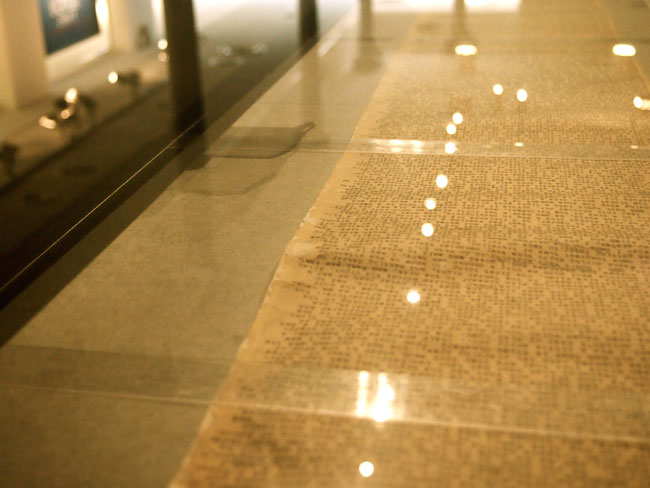
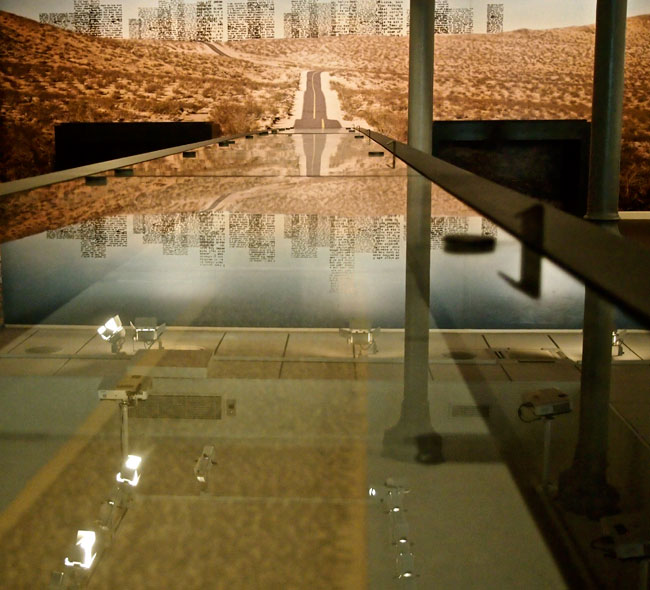
Paris is also, until August 19th, the place for Junior Beats to find their mandala: the legendary original scroll of On the Road, that hundred-word-a-minute novel sweated out by Jack Kerouac. His reputed masterpiece can be found in the small anteroom of the Musée des Ecrivains et Manuscrits at 220 Blvd Saint Germain.

About twenty feet of the scroll is laid out straight under glass, the rest rolled into thick hunks at both ends. The section presented is a straight block of text—on and on, a gray chunk that wanders relentlessly down, without the white space of paragraph headings or chapter breaks. Pages are connected every fifteen inches or so with strips of shiny tape. There are brief smudges here and there, penciled corrections that have faded almost to the color of the paper. The typed words are still legible, fiercely stamped with a mark both physical and textual. Letters ripple in the light, each one engraved by the imprint of a machine.

The rest of the exhibit features flimsy memorabilia of the Beat road trips: letterbag, typewriter, first editions, map and timeline, a smattering of photos from the recent movie. I try to look at the filler stuff but it all feels a bit too precious, nostalgic hoaxes collected in order to puff the room out. The scroll, as the centerpiece, commands all attention. I start at the top and read the whole of the visible text.

I must admit: I’ve never read the book.I used to dislike the Beats intensely. After moving from the East to West Coast at the age of thirteen, I didn’t appreciate the lack of history, the non-specificity of place that California presented. That which was supposed to liberate proved the opposite—I was unimpressed by the straightened highways, teaming with strip malls on either side. I didn’t take well to the myths surrounding their names—Burroughs shooting his wife, Ginsberg’s shouted “holy”s one after another, recklessness for the sake of pure pleasure, stragglers in the dust. As I began nursing literary pretensions in high school, I decided that I liked crafted prose, sentences with muscle, language obsessive to its task.  I wrote the Beats off as speed-typed cluster-fucks of language, masturbatory spreads.

I had read Kerouac’s Tristessa at the suggestion of a friend and felt it to be raw, oozing carelessly across the page, the heroine idealized and then demeaned, her very name reduced to atmosphere and emotion.

scroll

So I went to see the manuscript not so much to pay tribute, but rather distantly curious about the French perspective on such a prototypical American subject matter. And to see a glimpse of the Bay Area, where I live, in Paris, where I find myself this summer.

But I found that now I had started down the road, Iwanted to continue. On my way home I picked up a copy at Shakespeare & Co., the unedited version published by Penguin in 2007. Scroll now in hand, I began to read.

The manuscript text is breathless. Ellipses have two periods instead of three, a missed punctuation mark revealing the urgency of the recording process. The whole of the book could have been written in a singular exhale. One feels the act of writing contained in the words themselves, the three weeks when Kerouac sat down and spat it all out, constructing the scroll beforehand because he didn’t want to have to stop to change the paper, his wife bringing coffee after coffee in order to fuel the sleepless nights, rotating sweaty shirts as the frenzy of his writing soaked one after another.

Even as I sit on a park bench, comfortable in the sun and breeze, it is impossible not to get swept up in the energy. Reading the book urges conflicting impulses. On one hand I want to keep at it relentlessly, not lifting my eyes until the pages end. But On the Road is, if anything, a call to get on the road, to jump off the couch and walk out to the nearest crowd of people. The city becomes a promise, a promise that must be taken up with “immense vistas of the plains behind every sad street.”

Space and time collapse and then converge as everything between one place and the next is accounted for with a speedometer. Neal Cassidy drives from New York to Denver, pulls up to the porch with a “Hey there,” as if he had just been out to get some pop. The sixteen hundred kilometers from Denver to Chicago is made in a matter of hours on the wheels of a stolen car. The pursuit of the open road becomes an illicit one; the travelers want to cheat the clock, cheat the distance and, if that wasn’t already too much to ask, ultimately cheat death. “Life is not enough,” wrote Kerouac in a 1949 diary entry; On the Road makes you feel like it maybe can be enough, as long as you keep on reading and driving (going, going).

scroll

As time and space converges, the people do, too. In every roadside diner or jazz joint in the slums, there is a close childhood friend or former flame. And even if you don’t know anyone, you will get to know them. Formalities of both etiquette and syntax are forgotten as connections are made from person to person, word to word. No need for definite articles or polite banalities. For the traveler, those far from home, the idea is a beautiful one—that, after a few bucks spent on beer, strangers can become friends and the night ends in revelry for all.

This doesn’t mean that the road is an easy one. The book starts with the death of Jack’s father; a search for the Father is perhaps what prompts it all. Those who romanticize about it haven’t paid close enough attention. Every penny is accounted for; dinner is canned spaghetti or nothing at all. People sport bruises on their arms and cheeks from lovers’ quarrels, tired and exhausted of each other and the world. Casualties are noted with the name of each girl left behind, and there are many—a stream of escaped motels. The Gatsby-like Cassidy might pick up and leave, but Kerouac remembers, and wants us to remember, that people were lost or hurt along the way.

Highways are crossed one after the other on impulse; the text records a cartography of human love and desire, misdirected and confused as it is.  The journey is taken up, motives unknown, destination yet to be determined.

The book begins in springtime, with “everyone ready to go on some trip or another.” It’s like the prelude to Canterbury Tales, with people tapping their toes on the stoop, yearning to get out, get away, go and see something. In those days, the posture of a pilgrimage could be taken up. Now the journey is that which is must paid tribute to; without a destination, the means must become the end in itself, pretenses be damned.

Kerouac never found his hoped-for answer, his transient destination. The search went on after his return to New York; San Francisco proved an insufficient answer to the search “for joy, for kicks, for something burning in the night.” All those road trips weren’t enough. He had to sit down and write about them, eventually changing the details of plot and players so that the novel strayed further and further from reality.

Jack Kerouac's original sketch for the cover

Jack Kerouac's original sketch for the cover

On one of his hitchhikes Jack pulls out a map and consults the driver about the best way to get to the coast. The route, originally mapped out in a straight line due west, has to be modified with various bends and deviations. “It was my dream that screwed up,” he says,  “the stupid hearthside idea that it would be wonderful to follow one great red line across America instead of trying various roads and routes.”

The road foundon the manuscript is that dotted line; it tries to reconcile that which happened with that which was hoped for. One has to remember that Kerouac has, at that point, given up. He is stationary, at home. The urgency of the text is partly felt out of desperation, trying to reclaim what was lost, burned up in the exhaust of cars. On the Road becomes an elegy, celebratory and mournful at the same time.

I’m not sure how to straighten Paris out. Its clotted streets have been both invigorating and confusing. I came looking and hoping for a lot, and I don’t know if I’ve found it yet, and I don’t know if I will. But here, in San Francisco via Paris, in a home found through dislocation (of place, of narrative), I can take up the urge like never before.

Summer is almost over, and at the end of August I return to that white city on the West Coast. “Here I was at the end,” Jack says upon the sight of the Pacific Ocean “no more land. And now there was nowhere to go but back.” Yet in going back, in taking pen to paper, perhaps one can begin again.

{ 0 comments }

Noted #1

by HRM on August 13, 2012

A NEW SERIES

Noted

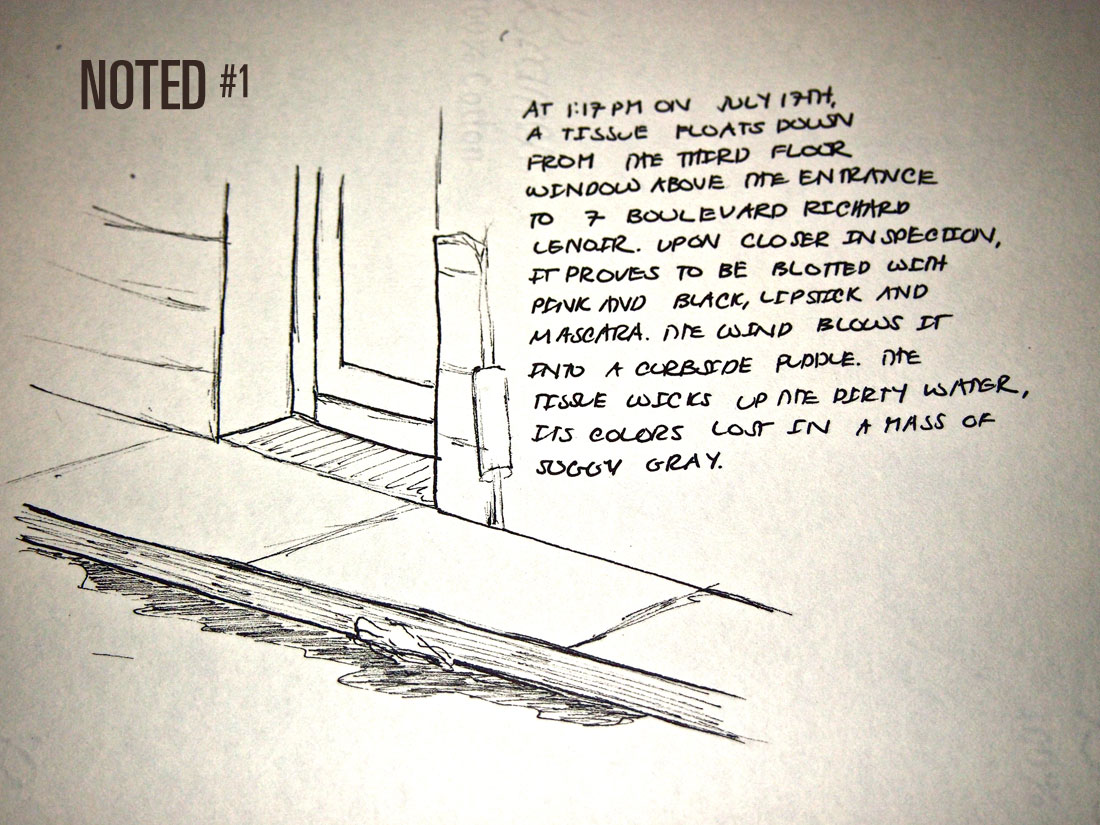
Our lives are made up of details, moments. The particular curvature of a tree branch overhead, dipping into our faces; a cigarette frozen in the icy sidewalk; a smashed window, allowing a glimpse of warehouse beams. Rain starts and stops; a potted plant falls over, scattering its dirt on the pavement.

Such observations are two-fold; they reveal a place as well as a perceiving eye, both the city and its inhabitant. Her Royal Majesty is starting a collection of such details to root the place in its irregularities and concrete forms.

Readers and contributors of HRM will be asked to capture and document a time, collectively and independently. The moments from all respective places will be published bi-monthly on our website.

You are invited to participate.

In order to transition from one place to another, and create the aesthetic of a cohesive series, some rules apply:

1. The location needs to be as specific as possible

2. An action needs to have happened, one that does not involve pigeons (much too common, and they can only do so many things). But the action can be small, i.e. involving a bee.

3. Exact time, down to the minute

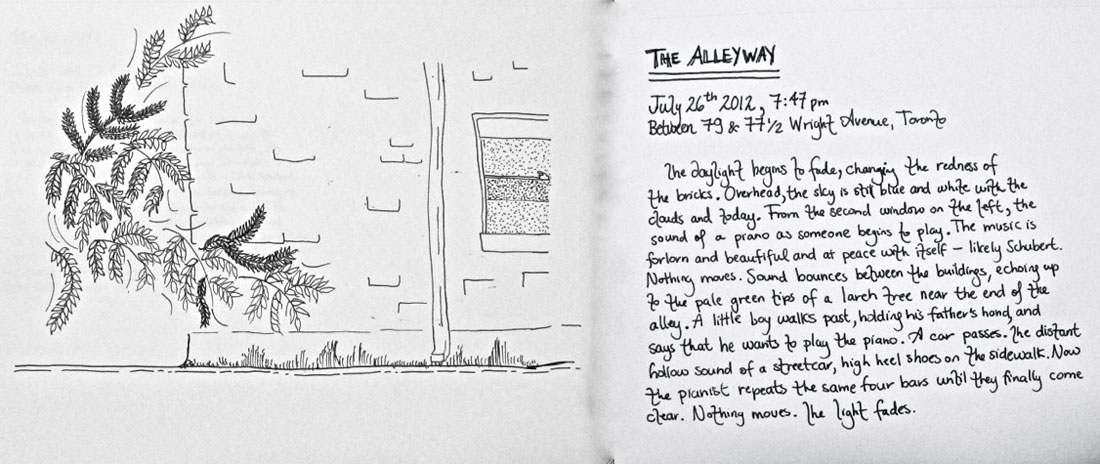
Here are some examples to get you started–three notes from Madison in Paris and one from Julia in Toronto. (click images to view larger)

Noted

Noted

Noted

contact Madison to submit your Notes: mmainwaring@middlebury.edu

{ 0 comments }

The Living Utopia

by HRM on August 4, 2012

Parisian artist Laurent Godard on Flateurville

by Franziska Knupper

“You are now officially crossing the border between real life and fiction!” Artist Laurent Godard opens the door of his Atelier with a grand gesture, “you will enter a whole new world situated right in the heart of Paris.” With a proud look on his face he presents this tiny part of the world of Flateurville, a fictional state he himself created and developed over several years. On the rue des Petits Ecuries in the 10th district of Paris, Laurent Godard has built a complete parallel universe in the vast space of his atelier.

Flateurville

So how can one imagine that? Entering the area of Flateurville you will be offered an ID card to become an official citizen, a Flateur. If you accept you will also be given a pair of glasses with one round and one square shaped glass – the official sign of Flateurville, also to be found on all the “national flags” hanging on the walls. “It works with every outfit,” he laughs, “and I assure you after some time you will not even notice anymore that the glasses are not alike.”

You will then wander through the different rooms of the building all playing an essential part in the fictional story of the state’s history. There is the bar where the national drug, the blue flower, can be consumed. There is the corner with the million sheets of paper, a script, telling the story of how the state came into existence. There are the numerous TV screens with live streaming from the other Flateur-locations across France. There is a garden space where the blue flower is grown. Rooms full of couches and 70s furniture, another with a defunct old car and stuffed animals on a child’s bed. It is a vivid exhibition space, a cabinet of curiosities, a lucid dream. And every Thursday, Laurent Godard opens the doors to the public, giving everyone the opportunity to have a look at his art, to wander around from room to room and to get acquainted with his idea of “Flateurville.” Then people can hear and give concerts, they can present and look at experimental video installation or performance art.

Flateurville

And then there are of course Godard’s huge paintings, covering the walls and portraying all the different citizens of Flateurville. Godard likes to work with varnish in all different colors, dripping it on the canvas like Jackson Pollock and letting it float until it reaches its own shape.

“I never work with models,” he says, “It doesn’t fit my style of painting. My work is impulsive, fast, coincidental.” Godard only does portraits, slightly deformed faces in all sizes and colors with eyes wide open, the Flateurs’ faces. “In real life it was me, Laurent Godard, who made those paintings. But in the world of Flateurville it was one special inhabitant called Marcel who created all this. That is also why this atelier carries the name ‘Hangar de Marcel.’ He is the artist of this space,” Godard explains.

Flateurville

Flateurville has its stories, its myths, its struggles and its distinct characters with their life stories. Godard has thought it through. Flateurville is a place of revolution, of drug trafficking, of prisons, of murder: “I know it may seem that in my vision, only the worst things of the world would come together. But I personally think that I created a living utopia – because in Flateurville the things are in the process of changing, the revolution is actually about to happen. It is dynamic, moving. That is a crucial point of the state’s development. And most important – the main aspect of life here is: Find the artist in yourself. Because art gives us the possibility to get rid of our destructive energy in a different way than by harming someone.”

{ 0 comments }

Straight to the Moon

by HRM on July 26, 2012

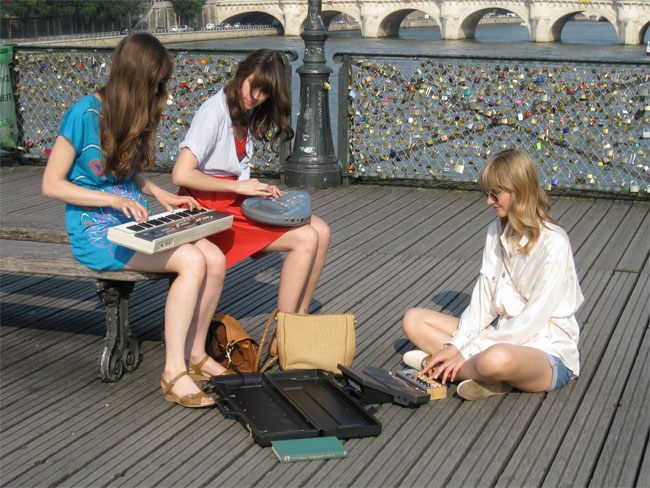
Brooklyn-based indie band Au Revoir Simone

Au Revoir Simone

Band-member Erika Forster DJ’d our NYC launch party in May. Now we turn to keyboard/vocalist Annie Hart to answer a few questions. Their last album, Still Night, Still Light (2009), has a crisp beat with delicate vocals, a dreamy pop with a melody that’s both bright and deft.

Describe the ideal event that your music would accompany?
A drive down a country road at sunset.  It winds down a hillside, with a creek to your right.  There are lots of evergreens and ferns with sunbeams shooting through.  And, of course, you are with someone you love and something tragic has happened that made you realize you love them more than you ever thought possible.

Au Revoir Simone is an all-keyboard band. Why the keyboard, for both you, Erika, and Heather? What are its strengths and limitations as an instrument?
Keyboards are awesome, that’s why!   The only limitation I feel is that it’s hard to get the harmonics of a distorted guitar when you play keyboard.  I’ve been listening to a lot of Superchunk lately and coveting that guitar sound.  We’ve been compensating on this new record we’re doing by using delays and phasers and I even bought a very fancy new (old) keyboard.  Very nice.

Au Revoir Simone has been together for nine years, and has issued three records. How has the band’s aesthetic and intention shifted over this time, from Verses of Comfort up to Still Night, Still Light?
I can’t say that I know that it has.  We have always strived for a particular sound, and are still on the hunt for it.  It’s an endless quest.

All three of the band’s members are women–quite unusual, on the indie music scene (and perhaps on the general music scene, too). How does your femininity influence your creative process, if it does at all?
I used to think that the only thing that set us apart from bands that are dudes was that we shared makeup and clothes.  But since I’ve played with other mixed-gender and all-female bands a bunch I’ve changed my mind.  I’ve noticed that bands composed of women tend to be much more collaborative than bands with men.  Even the sensitive, girly-type men that I favor for bandmates.

We get involved in each other’s parts like there’s no tomorrow and don’t have any ego about how we write.  We may love our parts or be endeared to them, but we’re never offended when someone else says she doesn’t like it.  It’s all about trust and openness.

Where are you drawing inspiration from these days?
The film “Synth Britannia,” our producer, Thom Monahan, Krautrock, and Robyn.

Where do you see the band going from here?
Straight to the moon.

aurevoirsimone.com

{ 0 comments }

ISSN: 2116 34X